Q1. Write an objective of Research (Mariyam)
Ans: Research objective is a concise statement describing what the research is trying to achieve. A well worded objective will be smart, that is specific, measurable, attainable, realistic and time-bound.
Research objective should be relevant, logical, observable, unequivocal and measurable. Objectives is a part purpose that can be reasonably achieved within the expected time-frame and with the available resources.
(pros) The objective or research problems summarises what is to be achieved by study.
The research objective are the specific accomplishment; the researcher hopes to achieve by the study.
The objective include obtaining answers to research question or testing the research hypothesis.
Q2. Write the Need for research objective (Mariyam)
The formulation of research objective will researcher to
With clearly defined objectives, the researchers can focus on the study.
The formulation of research objective helps the researcher avoid the collection of data which are not strictly necessary for understanding and solving the problem that he or she has defined.
The formulation of objective organises the study in clearly defined parts and phases.
Properly formulated
Specific objectives facilitate the development of research methodology and help orient the collection, analysis, interpretation, and utilization of data.
Objectives of Legal Research:
1. To discover new facts.
2. To test and verify old facts.
3. To analyse the facts in a new theoretical framework.
4. To examine the consequences of new facts or new principles of law or judicial decisions.
5) To develop new legal research tools of other discipline in the area of law.
6) To propound a new legal concept.
7) To analyse law and legal institutions from the point of view of history.
8) To examine the nature and scope of new law or legal institution.
9) To ascertain the merits and the demerits of old law or institution and to give suggestion for a new law or institution in place of an old one.
10) To ascertain the relation between legislature and judiciary and to give suggestion as to how one can assist the other in the discharge of one's duties and responsibilities.
11) To develop the principle of interpretation for critical examination of statute.
Q3. What are the process of Research? (Mariyam)
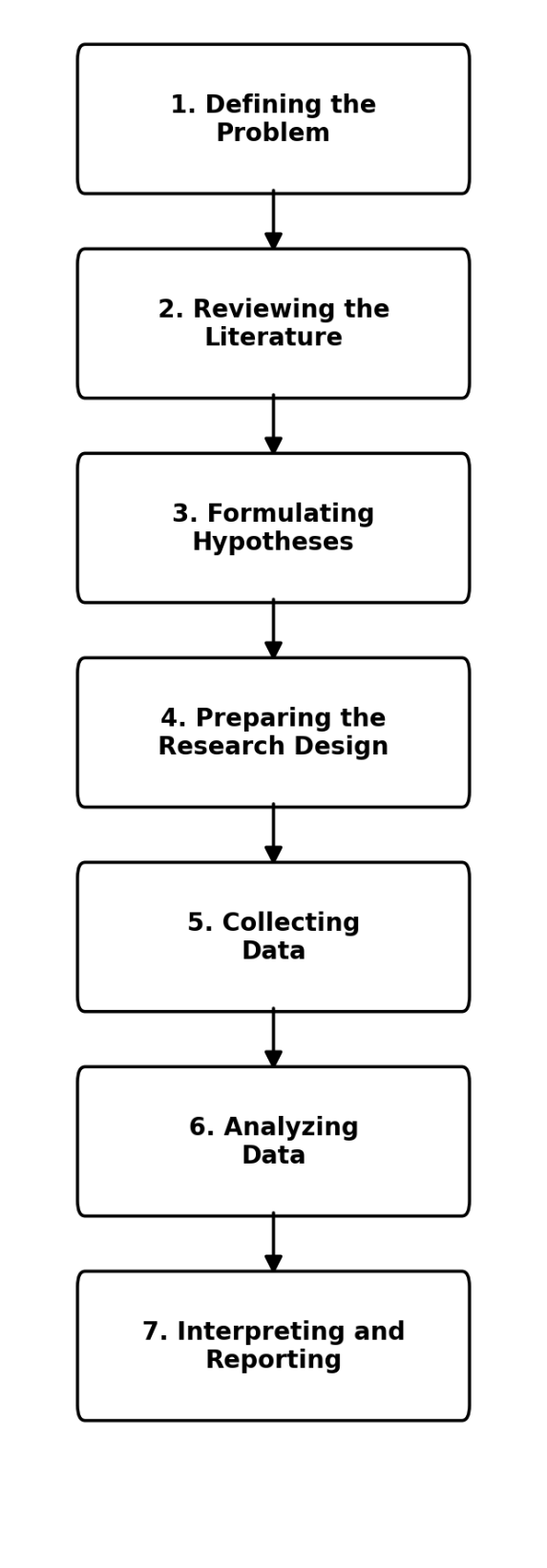 Ans:The research process in research methodology is a systematic, step-by-step path that guides a researcher from a broad idea to a proven conclusion. It includes defining a problem, reviewing literature, designing a plan, collecting and analyzing data, and reporting the final results
Key Steps in the Research Process
1. Defining the Problem
Choose a broad topic and narrow it down.
State the main research problem clearly.
Formulate specific research questions or objectives.
2. Reviewing the Literature
Read past books, journals, and studies.
Learn what is already known about the topic.
Find gaps that your study can fill.
3. Formulating Hypotheses
Create a testable guess or an expected answer.
State how variables might relate to each other.
Skip this step if your study is purely exploratory.
4. Preparing the Research Design(chart wise) (Flow chart)
Make a blueprint or plan for the study.
Choose a quantitative, qualitative, or mixed approach.
Decide on sample size and target groups.
5. Collecting Data
Gather raw facts using surveys, interviews, or tests.
Run experiments or observe behavior.
Record all findings in a safe and structured way.
6. Analyzing Data
Clean, edit, and code the raw information.
Use charts, graphs, or math formulas to find patterns.
Test your early guess against these results.
7. Interpreting and Reporting
Explain what the results mean.
State your final conclusions and study limits.
Write a clear report to share the new knowledge
Figure: The Research Process
Q4. Different types of research
Research:
The research is related to systematic investigation on the basis of the methodology of research and knowledge on a particular topic or subject, the user group, the research problem it investigates etc. According to Creswell (2003) need to focus on three methods like quantitative, qualitative and mixed method approaches.
Quantitative research methods are deals with numbers and amounts for describing an event that support the hypotheses and predication modal.
Qualitative research method enable researcher to use texts for findings, quality of subject and kind of providing picture from researcher view. Mixed method includes the mixing of both qualitative and quantitative data. Types of research shown in figure number 1.
Types of Research:
a. Pure Research or Basic Research:
The research carried out for new idea generation, new facts and fundamental principle for human knowledge.
Based on experimentation and observation by following rigorous standards and methodologies to meet specific objective and ensure credibility of conclusions of research published into pre-reviewed journals.
Pure research was studies on elements after Mendeleev's periodic table published and Penicillin discovery by Alexander Flaming was big step in discovery of antibiotic in medicinal science. Pure research is marvelous change setup of human mind and it generates knowledge and education. [1]
b. Applied Research:
Applied research main aim to discover solution, to provide knowledge and to applied social research data into decisions to solve problems associated with serious risks. With help of employing experimental research, accepted known theories, principles, case studies and interdisciplinary research one can solve certain problems.
Characteristics:
Solve problematic facts.
Without generalize objective studies individual or specific cases.
Represent how things can be changed.
Tries to correct problematic facts.[2]
Qualitative Research:
Qualitative research refers to much more subjective non-quantitative, use different methods of collecting data, analyzing data, interpreting data for meanings, definitions, characteristics, symbols metaphors of things. Qualitative research further classified into following types:
Ethnography:
This research mainly focus on culture of group of people which includes share attributes, language, practices, structure, value, norms and material things, evaluate human lifestyle. Ethno: people, Grapho: to write, this disciple may include ethnic groups, ethno genesis, composition, resettlement and social welfare characteristics.
Phenomenology:
It is very powerful strategy for demonstrating methodology to health professions education as well as best suited for exploring challenging problems in health professions educations.
Case Study Research:
It is used to generate deep understanding of complex issue in real life matter. It involve wide variety of principle in medicine for examine patient.
Quantitative Research:
Quantitative research aim to measure numeric figures, quantity, amounts, used extensively in field of economics and commerce. Quantitative research refers as systematic empirical investigation of phenomena quantitative data and their relationship. [3]
c. Descriptive Research:
The research which is determines "the way things are". The descriptive research may include behavior observation research, you can observe a lot by watching and survey research.
Types of Descriptive Research:
Observational Method
Survey Method
Case Study Method
a. Observation Method: This is type of correlation research which adopt researcher observes ongoing behavior. There may be 3 types of approach for observational researches are covert observation, overt observation and research participation.
b. Survey Method: The brief interview or discussion with some person about relevant topic. It is used to take opinion, thought and feelings. In this predetermined set of question should give to the indulging of population interest towards.
c. Case Study Method: These studies are related to analysis of events, periods, persons, decisions, policies, and institutions studied by one or more methods. Study is conducted on the basis of inquiry of subject instance of class of phenomena that provides an analytical frame. [4]
d. Analytical Research:
It is related with carrying analysis on certain phenomenon with the help of analytical tools. Analytical research used already available facts and information; analyze them to make critical evaluation.
Type of Analytical Research:
a. Reviews: The search involves meta-analysis of quantitative methods of review. It also relates with making formal assessment of various research with intension of making any useful change or conclusion if necessary.
b. Historical Research: It is a systematic collection and evaluation of data to explain, understand events, action and describe that occurred in past. Historical research source material may include documents, numerical records, oral statements and records. The main aim of historical research to find critical search for truth to conceptualize, histories and contextualize to explain there is no agreed definition of what time period constituted on temporary history has existed or can exist.
c. Philosophical Research: This research is related to the theoretical bases of branch of experience and knowledge which is fundamental in nature of reality, knowledge and existence.
d. Research Synthesis: To summarizing the facts related with particular question, two or more research studies are assessed.
Techniques of Survey Research are:
Questionnaires
Interviews
Survey
e. Grounded Theory: Grounded theory out of many discoveries or construction theories and their data obtained systematically with the help of comparative analysis. The methodology after revision should be more flexible and widely adopted to assume reality of external world. This may include qualitative data, interviews, and review of records, surveys and observations.
These research place priorities on study phenomenon over method of study, the researcher role are important in creating categories and interpreting data beside strategies as tools or prescriptions. [5]
e. Fundamental Research:
To acquire the new knowledge experimentation and theoretical work has to done primarily. It increases scientific knowledge of researcher and has no planned or immediate uses, their results may be useful in future.
Benefits of Fundamental Research
Economical gaining
Benefits to society
New knowledge acquisition
f. Conceptual Research:
The research is conducted on the basis of already present information and observation on given topic. It can be used in developing theories or new interpretation by abstract concepts and ideas.
While conducting a conceptual research, choose the topic, collect relevant literature, identify specific variables, generate the framework, this type of research is mainly relies on previously conducted studies, already existing relevant information and literature.
g. Empirical Research:
This type of research based on collection of data which lead to generation of new ideas, observation and experiments or by using scientific instruments.
The study conclusion is drawn from concretely empirical evidence and verifiable evidence. It is derived from Greek word Empeirikos which means "experienced".
h. Longitudinal Research:
In this type of research, we conduct much observation of subject variables for long time (over a weeks, months and years), without interfere with subject.
Collection of data at the onset of study and gather repeatedly over a period of time depends on length of study to observe how variable change in this duration.
Main importance of longitudinal research is in studying development and lifespan issues.
Types of Longitudinal Studies:
a. Retrospective Study: This study may involve to looking at historic information for past records.
b. Cohort Analysis: In this type of study group being selected based on historical, geographic, birth.
c. Panel Study: Involves sampling a cross-section of individuals. [6]
i. Laboratory Research:
In laboratory research provide conditions with technological research, measurement and experiments are to be performed.
Any chemical substances, microscopically, parasitological, hematological, immunological, biochemical, tissue culture research can be carried out into laboratory.
It involves study of natural science with experiments.
j. Exploratory Research:
This research is conducted for not clearly defined problems. It helps to determine data collection method, research design and selection of subjects.
It depends on reviewing of literature, information collection through informal discussion with consumer's competition.
Way to implement exploratory research into research plan. We need to focus on groups mainly contain 8 to 12, ask them relevant question on subject and issue being searched. [7]
k. Conclusion Oriented Research:
This research deal with redesign enquiry, to pick up problem and prepared to conceptualize.
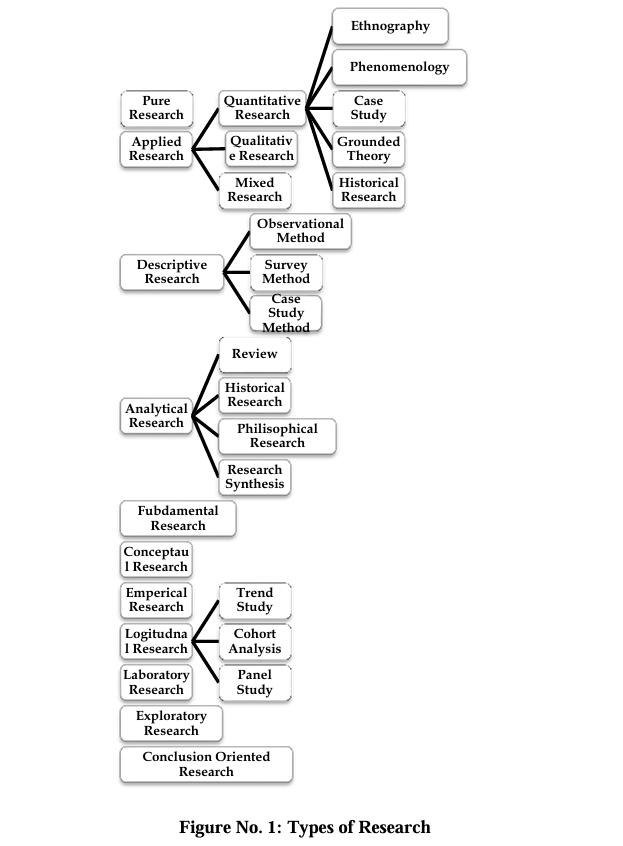
Figure No. 1: Types of Research
Q5. A. Explain the different types of research design.
A research design is defined as the overall plan or structure that guides the process of conducting research. It is a critical component of the research process and serves as a blueprint for how a study will be carried out, including the methods and techniques that will be used to collect and analyze data. A well-designed research study is essential for ensuring that the research objectives are met and that the results are valid and reliable.
Key elements of research design include:
Research Objectives: Clearly define the goals and objectives of the research study. What is the research trying to achieve or investigate?
Research Questions or Hypotheses: Formulating specific research questions or hypotheses that address the objectives of the study. These questions guide the research process.
Data Collection Methods: Determining how data will be collected, whether through surveys, experiments, observations, interviews, archival research, or a combination of these methods. Data collection methods may include surveys, interviews, and observations, often supported by survey and idea collection platforms that centralize responses and analysis.
Sampling: Deciding on the target population and selecting a sample that represents that population. Sampling methods can vary, such as random sampling, stratified sampling, or convenience sampling.
Data Collection Instruments: Developing or selecting the tools and instruments needed to collect data, such as questionnaires, surveys, or experimental equipment.
Data Analysis: Defining the statistical or analytical techniques that will be used to analyze the collected data. This may involve qualitative or quantitative methods, depending on the research goals.
Time Frame: Establishing a timeline for the research project, including when data will be collected, analyzed, and reported.
Ethical Considerations: Addressing ethical issues, including obtaining informed consent from participants, ensuring the privacy and confidentiality of data, and adhering to ethical guidelines.
Resources: Identifying the resources needed for the research, including funding, personnel, equipment, and access to data sources.
Data Presentation and Reporting: Planning how the research findings will be presented and reported, whether through written reports, presentations, or other formats.
There are various research designs, such as experimental, observational, survey, case study, and longitudinal designs, each suited to different research questions and objectives. The choice of research design depends on the nature of the research and the goals of the study.
A well-constructed research design is crucial because it helps ensure the validity, reliability, and generalizability of research findings, allowing researchers to draw meaningful conclusions and contribute to the body of knowledge in their field.
10 Types of Research Design
Understanding the intricate tapestry of research design is pivotal for steering your investigations toward unparalleled success. Dive deep into the realm of methodologies, where precision meets impact, and craft tailored approaches to illuminate every research endeavor.
1. Experimental Research Design: Mastering Controlled Trials
Delve into the heart of experimentation with Randomized Controlled Trials (RCTs). By randomizing participants into experimental and control groups, RCTs meticulously assess the efficacy of interventions or treatments, establishing clear cause-and-effect relationships.
2. Quasi-Experimental Research Design: Bridging the Gap Ethically
When randomness isn’t feasible, embrace the pragmatic alternative of Non-equivalent Group Designs. These designs allow ethical comparison across multiple groups without random assignment, ensuring robust research conduct.
3. Observational Research Design: Capturing Real-world Dynamics
Capture snapshots of reality with Cross-Sectional Studies, unraveling intricate relationships and disparities between variables in a single moment. Embark on longitudinal journeys with Longitudinal Studies, tracking evolving trends and patterns over time.
4. Descriptive Research Design: Unveiling Insights Through Data
Plunge into the depths of data collection with Survey Research, extracting insights into attitudes, characteristics, and opinions. Engage in profound exploration through Case Studies, dissecting singular phenomena to unveil profound insights.
5. Correlational Research Design: Navigating Interrelationships
Traverse the realm of correlations with Correlational Studies, scrutinizing interrelationships between variables without inferring causality. Uncover insights into the dynamic web of connections shaping research landscapes.
6. Ex Post Facto Research Design: Retroactive Revelations
Explore existing conditions retrospectively with Retrospective Exploration, shedding light on potential causes where variable manipulation isn’t feasible. Uncover hidden insights through meticulous retrospective analysis.
7. Exploratory Research Design: Pioneering New Frontiers
Initiate your research odyssey with Pilot Studies, laying the groundwork for comprehensive investigations while refining research procedures. Blaze trails into uncharted territories and unearth groundbreaking discoveries.
8. Cohort Study: Chronicling Evolution
Embark on longitudinal expeditions with Cohort Studies, monitoring cohorts to elucidate the evolution of specific outcomes over time. Witness the unfolding narrative of change and transformation.
9. Action Research: Driving Practical Solutions
Collaboratively navigate challenges with Action Research, fostering improvements in educational or organizational settings. Drive meaningful change through actionable insights derived from collaborative endeavors.
10. Meta-Analysis: Synthesizing Knowledge
Combine perspectives gleaned from various studies through Meta-Analyses, providing a comprehensive panorama of research discoveries.
By honing in on the nuances of each research design and aligning your content with strategic SEO principles, you can ascend to the zenith of search engine rankings and establish your authority in the domain of research methodology.
Top 16 Research Design Methods
Research design methods refer to the systematic approaches and techniques used to plan, structure, and conduct a research study. The choice of research design method depends on the research questions, objectives, and the nature of the study. Here are some key research design methods commonly used in various fields:
1. Experimental Method
Controlled Experiments: In controlled experiments, researchers manipulate one or more independent variables and measure their effects on dependent variables while controlling for confounding factors.
2. Observational Method
Naturalistic Observation: Researchers observe and record behavior in its natural setting without intervening. This method is often used in psychology and anthropology.
Structured Observation: Observations are made using a predetermined set of criteria or a structured observation schedule.
3. Survey Method
Questionnaires: Researchers collect data by administering structured questionnaires to participants. This method is widely used for collecting quantitative research data.
Interviews: In interviews, researchers ask questions directly to participants, allowing for more in-depth responses. Interviews can take on structured, semi-structured, or unstructured formats.
4. Case Study Method
Single-Case Study: Focuses on a single individual or entity, providing an in-depth analysis of that case.
Multiple-Case Study: Involves the examination of multiple cases to identify patterns, commonalities, or differences.
5. Content Analysis
Researchers analyze textual, visual, or audio data to identify patterns, themes, and trends. This method is commonly used in media studies and social sciences.
6. Historical Research
Researchers examine historical documents, records, and artifacts to understand past events, trends, and contexts.
7. Action Research
Researchers work collaboratively with practitioners to address practical problems or implement interventions in real-world settings.
8. Ethnographic Research
Researchers immerse themselves in a particular cultural or social group to gain a deep understanding of their behaviors, beliefs, and practices.
9. Cross-sectional and Longitudinal Surveys
Cross-sectional surveys collect data from a sample of participants at a single point in time.
Longitudinal surveys collect data from the same participants over an extended period, allowing for the study of changes over time.
10. Meta-Analysis
Researchers conduct a quantitative synthesis of data from multiple studies to provide a comprehensive overview of research findings on a particular topic.
11. Mixed-Methods Research
Combines qualitative and quantitative research methods to provide a more holistic understanding of a research problem.
12. Grounded Theory
A qualitative research method that aims to develop theories or explanations grounded in the data collected during the research process.
13. Simulation and Modeling
Researchers use mathematical or computational models to simulate real-world phenomena and explore various scenarios.
14. Survey Experiments
Combines elements of surveys and experiments, allowing researchers to manipulate variables within a survey context.
15. Case-Control Studies and Cohort Studies
These epidemiological research methods are used to study the causes and risk factors associated with diseases and health outcomes.
16. Cross-Sequential Design
Combines elements of cross-sectional and longitudinal research to examine both age-related changes and cohort differences.
The selection of a specific research design method should align with the research objectives, the type of data needed, available resources, ethical considerations, and the overall research approach. Researchers often choose methods that best suit the nature of their study and research questions to ensure that they collect relevant and valid data.
Research Design Examples
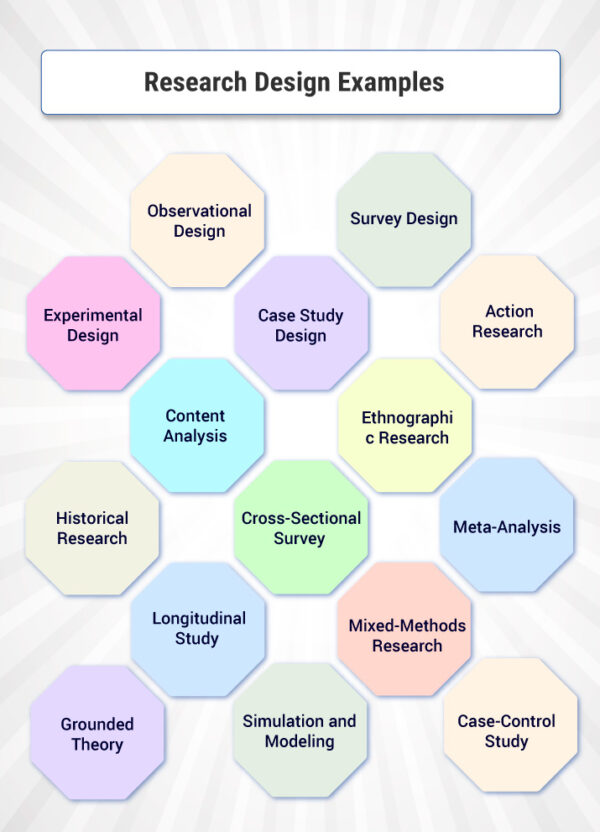
Research designs can vary significantly depending on the research questions and objectives. Here are some examples of research designs across different disciplines:
Experimental Design: A pharmaceutical company conducts a randomized controlled trial (RCT) to test the efficacy of a new drug. Participants are randomly assigned to two groups: one receiving the new drug and the other a placebo. The company measures the health outcomes of both groups over a specific period.
Observational Design: An ecologist observes the behavior of a particular bird species in its natural habitat to understand its feeding patterns, mating rituals, and migration habits.
Survey Design: A market research firm conducts a survey to gather data on consumer preferences for a new product. They distribute a questionnaire to a representative sample of the target population and analyze the responses.
Case Study Design: A psychologist conducts a case study on an individual with a rare psychological disorder to gain insights into the causes, symptoms, and potential treatments of the condition.
Content Analysis: Researchers analyze a large dataset of social media posts to identify trends in public opinion and sentiment during a political election campaign.
Historical Research: A historian examines primary sources such as letters, diaries, and official documents to reconstruct the events and circumstances leading up to a significant historical event.
Action Research: A school teacher collaborates with colleagues to implement a new teaching method in their classrooms and assess its impact on student learning outcomes through continuous reflection and adjustment.
Ethnographic Research: An anthropologist lives with and observes an indigenous community for an extended period to understand their culture, social structures, and daily lives.
Cross-Sectional Survey: A public health agency conducts a cross-sectional survey to assess the prevalence of smoking among different age groups in a specific region during a particular year.
Longitudinal Study: A developmental psychologist follows a group of children from infancy through adolescence to study their cognitive, emotional, and social development over time.
Meta-Analysis: Researchers aggregate and analyze the results of multiple studies on the effectiveness of a specific type of therapy to provide a comprehensive overview of its outcomes.
Mixed-Methods Research: A sociologist combines surveys and in-depth interviews to study the impact of a community development program on residents’ quality of life.
Grounded Theory: A sociologist conducts interviews with homeless individuals to develop a theory explaining the factors that contribute to homelessness and the strategies they use to cope.
Simulation and Modeling: Climate scientists use computer models to simulate the effects of various greenhouse gas emission scenarios on global temperatures and sea levels.
Case-Control Study: Epidemiologists investigate a disease outbreak by comparing a group of individuals who contracted the disease (cases) with a group of individuals who did not (controls) to identify potential risk factors.
These examples demonstrate the diversity of research designs used in different fields to address a wide range of research questions and objectives. Researchers select the most appropriate design based on the specific context and goals of their study.
Q5. B. Different Types of Research Design
Research Design:
Research design is used to reduce the costs, bear a significant control on the consistency of the results accomplished, provides a solid base for the complete research.
With the help of preplanning, it is possible to minimum spending money, effort and to get maximum information. Research design is used to collect the relevant data and technique to facilitate the smooth scaling of the various research operations making yielding maximal information.
Poor groundwork of research design displeases the entire project. Types of research design shown in figure number 2. 
Figure No. 2: Types of Research Design
Types of Research Design:
A researcher must have knowledge of various types of research designs to choose which type of research design should be applied for the research. There are different types of research designs which are explained below.
a. Descriptive Design:
Descriptive design includes phenomena being researched and characteristics of population. To describe internal validity does not require characteristics of population. It used for statistics of data, average and frequencies.
Advantage:
Amount of data gathered by this research and which can be used for future references.
It gives overviews of study which is helpful to determines variables used for study.
Limitation of study can use for development or as a useful tools.
Disadvantage:
To disapprove hypothesis, outcome of descriptive design cannot be used.
Study depends on measurement and instrumentation for observation.
Using observational method outcome can be collected.
b. Exploratory Design:
Design used for research where no design study is done before. Later investigation can be best understood to get knowledge through this design. The study used for explanation whether future study is possible or not and data can be used for further development for more research.
Advantage:
Research priority can be determined through exploratory design.
All answer like What, Why, how we can get through data collection.
Background data can be collected through exploratory design for particular topic.
Disadvantage:
Whole population can be generalizing through data of exploratory research.
Unstructured style of research.
This design is followed to realize following purposes:
Clarifying concepts and defining problem.
Formulating problem for more precise investigation.
Increasing researcher's familiarity with problem.
Developing hypothesis.
Establishing priorities for further investigation.
c. Experimental Design:
The casual relationship where particular cause leads to same effect, cause will proceed to effect so degree of associate is major.
The procedure is main which controls all factors of experiment.
Experimental design uses more measurements and more groups for longer periods of time.
Advantage:
Placebo effects can be determined from treatment effects.
From single study high level of evidence can be collected.
It determines cause of something to take place.
Disadvantage:
Because of technical or ethical reasons few types of proceeds cannot be performed.
It might not fit into real time.
If procedure uses special equipment and facilities, experiments can be costly.
Basic Principles of Experimental Design:
Principle of replication
Principle of randomization
Principle of local control
Types of Experimental Design
Pre-experimental
True experimental
Quasi experimental
Pre-Experimental Design:
After implementing factors of effect and causes various groups are kept under observation. The research is conducted to understand investigation necessary for particular group.
Types of Pre-Experimental Research:
Static-group comparison
One-shot case study research design.
One group pretest posttest research design
True Experimental Research Design:
To prove or disprove hypothesis statistics analysis required. To build relationship between (cause effect) groups, a true design required. It needs random distribution, variable can be manipulated and control group is not changed. [8]
d. Longitudinal Design:
This research design makes multiple observation, repetitive study and experiments. This involved same group of people for study over period of time.
The variable are identify and cause are found which made variable have caused change in their behavior. This also called panel research design.
Advantage:
Data can be collected from particular phenomenon.
Various variable established causal relationship.
Pattern of change can be tracked.
Disadvantage:
Method is changed over time, but researcher assumes that present trend may remain same for future also.[9]
e. Cross-Sectional Design:
The research design calculated among study participants at some time. Research variable data analyze from sample population which is collected from given point of time.
It has selection based on differences rather than selection, dependence based on existing variations; no time dimension so distinguishing features can be analyzed.
Advantage:
Study used for large number of subjects.
Grouping not selected, randomly based on population grouping is done.
At a point in time provides characteristics of result.
Results performed on population are more reliable.
Use large number of subject involves.
Disadvantage:
Very difficult to find same interest phenomena or subjects.
Outcome does not provide any historical occurrence because of time-bound procedures.
Different outcome from different time-frame.
Cause and effect relationship cannot be determined from this research.
f. Action Research Design:
In this exploratory and understanding of problem is developed to follow characteristic based path to made strategies of intervention. Various forms are collected to follow new intervention strategies until problem strategies established. This path is cyclic; provide initializing, hypothesizing and specifying problem to make interventions and assessments.
Advantage:
Because of cooperative and adaptive nature it can be used in community or world situation.
It mainly focuses on solution driven and practical besides than theories.
It increases change of learning from experiences also viewed as cyclic.
Outcome is related to practice.
Researcher has nothing to hide and controlled information.
Disadvantage:
It is responsibility of researcher to enhance change so difficult to perform conventional studies.
Test result may be bias one due to over-involvement of researcher.
Documentation is really difficult because of no standard format.
It is cyclic in nature so action research is difficult to conduct.[10]
g. Cohort Research Design:
This study conducted on short population over a period of time. It is generally deal with statistics section of population which is relevant to investigational problem.
Open-cohort study involve rate-based data and closed-cohort involve all participant enter in study at a specific point, no new participant allowed in later.
Advantage:
Action research study is mandatory because involving random people in study is unethical so it is a risk-based study.
To provide insights into overtime effect, study should be flexible.
Primary source and secondary source data can be used.
Need to avoid debate related to cause and effects because, it can gauge probable cause before outcome.
Disadvantage:
No involvement of randomization, so lower than other research which select random participant.
Research has to wait for condition because it takes long time, so result credibility may change by variable.
Factor between two cohort groups cannot be controlled.[12]
h. Casual Design:
They relates with understanding of phenomenon with statements "If A, then B". According to assumptions and norms one can made certain changes in this kind of research.
The explanation of test by hypothesis seeks by majority of scientists like dependent variable, independent variable, variation in one phenomenon, variation in other phenomenon.
The following impact need to include in casual design:
Non-Superiorness:
The relationship independent of variation and between two variables is called third variable.
Appropriate Time Order:
Before dependant variable independent variable must be tackled.
Empirical Associate:
Finding relationship between dependant and independent variables.
Advantage:
Chances of replicate are more.
Study has systematic subject selection and has internal validation.
It helps the word better understanding by providing link between variables and eliminates possibilities.
Disadvantage:
Two different events seem to be related and cannot be casual.
Causality only inferred but because variable superfluous and perplexing variable exist so difficult to determine conclusion about relationship.
It is not easy to predict which variable is cause and which is effect.[13]
Q4. B. Types of Research (Pritam)
There are 6 types of Research , they are:-
Doctrinal Research
Doctrinal research (also referred to as theoretical, pure legal, academic, traditional, conventional, armchair research) is essentially a library-based study, which means that the materials needed by a researcher may be available in libraries, archives and other data-bases. The basic aim of such research is to discover, explain, examine, analyse and present, in a systematic form, facts, principles, provisions, concepts, theories or the working of certain laws or legal institutions. Speaking generally, the objectives of such research are the same as outlined earlier in this chapter.
'Justice', 'fairness', 'protection of rights', 'freedom' and 'liberty' are often used by the researcher as the criterion to evaluate the relevance or effectiveness of laws, concepts or legal institutions. The underlying aim of such research is to gain and present new knowledge and ideas or to suggest change and reform.
Empirical Research / Socio-Legal Research
Socio-legal research (also termed as non-doctrinal, field-study, empirical research) refers to the study of some aspect of 'law in operation', 'law in context', 'law in action', which means a study of how law operates in a social context or how law deals (or should deal) with a social problem, issue or question.10
The term socio-legal research is used to refer to a study that combines legal research with an investigation of some problem or question which is essentially of a 'social' nature, and uses techniques of data collection used in social science research. Usually the underlying aim of such study is to determine the nature and extent of the adequacy or inadequacy of the existing law, or the need for a new law, or to ascertain whether an efficacious use of law can offer some kind of solution or answer to a problem or question or whether law can be used as an instrument of control, change and reform.
There is a growing realisation that research studies in the field of law should not be confined to pure legal matters (such as legal principles, rules or legal institutions) and that research should, where it is relevant and useful, cover some kind of social study. Some of its basic features are stated below:
(a) Social research is a systematic study into social, political or other fact-conditions, to discover unknown or partly known factors working behind a particular phenomenon or to understand why something happens and to draw inferences and general conclusions.
(b) It is an attempt to ascertain why and how human beings behave in a certain way in certain factual situations, such as to find out why drug abuse is more common among certain groups of people living in certain geographical areas than in others.
(c) It is to identify the cause and effect of a certain problem, such as to find out why prisons in a certain geographical area are overcrowded and what are the possible effects of overcrowding on the inmates or prison-management. Or, why there is huge backlog of cases in certain courts and its effects on the affected parties. Or, why there is a sharp rise in certain type of offences and what is its effect on public attitude and social life. The fundamental assumption on which social research is based is that there is a cause and effect relationship. If the causes of the occurrence or existence of a certain behaviour, event or phenomenon can be identified by empirical study, it may be possible to control, minimise or eliminate them.
(d) Social research may often be carried out with a view to ascertaining people's ideas, views, attitudes or values on a certain legal or social problem or question. Many surveys and opinion polls are carried out with this object in view. Every society faces a multitude of problems. The factors responsible for their emergence or existence may be wide and varied. Some may be known, others unknown. A study that seeks to find the causes of a problem with the help of people's knowledge, views and attitudes may often be useful in any search for finding a solution. Law alone may not necessarily be an answer to a social problem. But where factors are sufficiently identified, appropriate laws, effectively enforced, may surely be helpful in dealing with the problem.
(e) Social research is essentially a field-study, where a hypothesis is usually framed and then sought to be tested or verified, or a question is raised and sought to be answered. It is carried out by collecting data and information using the methods developed by the social sciences, such as sociology, psychology, criminology, education. The methods used in social research are observation, content analysis, case studies, or survey research using interviews and questionnaires. The knowledge gained by using such methods may enable the researcher to arrive at some conclusion as to whether the hypothesis has been proved or disproved. For example, a study may be conducted to find out whether anti-smoking regulations, which prohibit smoking in air-conditioned or certain designated places have achieved their objective and what factors account for their failure if such regulations have not succeeded in their desired goal, and what legal, administrative or policy measures may further be needed. Or, a study may be undertaken to ascertain the nature and extent of workplace harassment of female workers in certain type of working environment, and what legal or other remedial measures may be appropriate.
Comparative Research
A research may involve, either wholly or partly, the study of some legal problem, issue or question in a comparative perspective. A researcher may find it worthwhile to examine similarities and dissimilarities between two situations existing within the same legal system, such as the existence and scope of application of certain customary principles in a particular state and the position in any other part of the country. Or, a researcher may study the nature, and effects of special laws governing tax and housing in a particular area on the economic and social development in that area compared with regulations applicable in some other parts of the country. Or, a researcher may study questions such as drug addiction and use, delinquency, workplace harassment, a higher incidence of poverty in certain geographical areas or in certain social groups, in order to consider whether special legal and administrative measures would be needed to minimise such problems.
Similarly, a research may involve a study of some problem, issue or question in one legal system and a comparison with the position as it may exist in some other legal system. A researcher may, for example, examine the nature and scope of inheritance rights of women or rules governing contractual transactions under some law, and the nature of rules applicable in such cases under any other legal system. Or, a researcher may find it worthwhile to study the effects of the application of the doctrine of privity of contract on the rights and interests of third parties and examine how and to what extent English courts in some cases as well as a parliamentary law, the Contract (Rights of Third Parties) Act 1999, have sought to protect third party rights in contractual transactions in specified situations. Or, a study may be made of the recent judicial trends in English courts on the scope and extent of wife's liability, where she acts as surety for her husband's debts in mortgage transactions involving matrimonial home, and the principles determined by courts may be examined in a comparative analysis with the existing Indian law.
The objective of comparative research may either be to present information, existing in two or more different factual contexts, or to examine merits and demerits in a comparative perspective, or to compare and contrast views, ideas, values, concepts, rules, principles, theories, or any other condition that has some bearing on law or its institutions. The purpose of a legal research may be to bring about improvement in law, so that it may work more effectively and efficaciously. A comparative approach to law research may have the same purpose.
It may be emphasised here that in academic institutions, especially where the aim of a study is to prepare a dissertation or thesis, the research in most cases involves the use of more than one approach. Where a researcher traces the history and development of something relevant to the study, that part of the research involves by definition a 'historical approach'. The same is true where, for example, a study involves description, analysis, criticism, or comparison. Such a study (wholly or partly) may be termed as descriptive, analytical, critical, or comparative.
Statical Research
Statistical research (often referred to as quantitative research, data-driven research, or numerical analysis) refers to the systematic investigation of phenomena through the collection, organization, analysis, interpretation, and presentation of numerical data. It focuses on converting concepts, operational behaviours, and societal patterns into measurable quantities to identify patterns, test hypotheses, and draw objective conclusions.
The term statistical research is used to refer to a study that applies mathematical and statistical methods to empirical data to evaluate problems, assess relationships between variables, and make predictions. Usually, the underlying aim of such a study is to provide objective evidence regarding the frequency, intensity, or extent of a phenomenon, enabling researchers and policymakers to move beyond anecdotal evidence and make data-informed decisions.
There is a growing realization across various disciplines—including law, economics, social sciences, and healthcare—that qualitative analysis alone is often insufficient, and that empirical findings must be supported by sound quantitative evidence. Some of its basic features are stated below:
(a) Quantitative Measurement and Objectivity: Statistical research relies on measuring variables numerically (such as percentages, rates, averages, and proportions) to minimize subjective bias and ensure that findings can be independently tested and verified.
(b) Sampling and Generalizability: It involves selecting a representative sample from a larger target population. By analyzing the sample using probability theory, researchers can draw reliable inferences and generalize their findings to the entire population within measurable margins of error.
(c) Testing Hypotheses and Relationships: It provides statistical tests (such as chi-square tests, t-tests, ANOVA, and regression models) to evaluate whether an observed relationship between two or more variables is statistically significant or merely the result of random chance.
(d) Trend Analysis and Forecasting: Statistical research enables researchers to track trends over time, identify historical patterns, and construct predictive models to forecast future outcomes, behaviour, or economic shifts.
(e) Standardized Data Collection: It heavily relies on structured, repeatable tools for data collection—such as standardized surveys, census data, experimental logs, or official databases—ensuring high consistency and comparability across different studies or time periods. For example, a statistical research project might analyze national crime records to calculate reoffending rates among probationers, or evaluate the percentage decrease in traffic accidents following the implementation of stricter traffic penalties.
Analytical and Critical Research
Analytical and critical approach is quite different, in its method of treatment, from a descriptive or explanatory approach. Analytical approach involves a careful examination and evaluation of something in order to understand or explain it or draw inferences and conclusions from it.
Critical approach is similar to this approach except that in a critical approach the researcher examines and judges things carefully, points to the inadequacies, drawbacks or disadvantages, expresses his or her own opinion, and approves or disapproves something on some rational basis. Indeed much legal research entails critically assessing various issues involved, along with whatever other purpose it might seek to serve.
Legal research in academic institutions, in most cases, focuses on analysis of facts and information available on any problem, issue or question. Such an approach involves an examination of rules, principles, cases, concepts, theories or institutions. The nature of the analysis and examination obviously depends on the objective a researcher has in mind, because a legal study may be conducted for a variety of purposes. At present legal research is predominantly concerned with law reform. The society is facing new challenges every day and law is confronted with new problems. The existing law is often found inadequate or inappropriate to deal with such problems. The purpose of a study may often be to analyse and examine the nature, purpose and adequacy of law in any particular area of social, economic or political life, and then suggest ways in which changes may be introduced or evaluate the extent to which changes may succeed to achieve desired results.
Other Research
Beyond the standard other ways research types include- cross-sectional studies, case-control studies, quantitative and qualitative enquiries, systemic review, meta analysis, multiple studies combining all the research for a stronger research.
Q6. Quantitative vs Qualitative Research (Pritam)
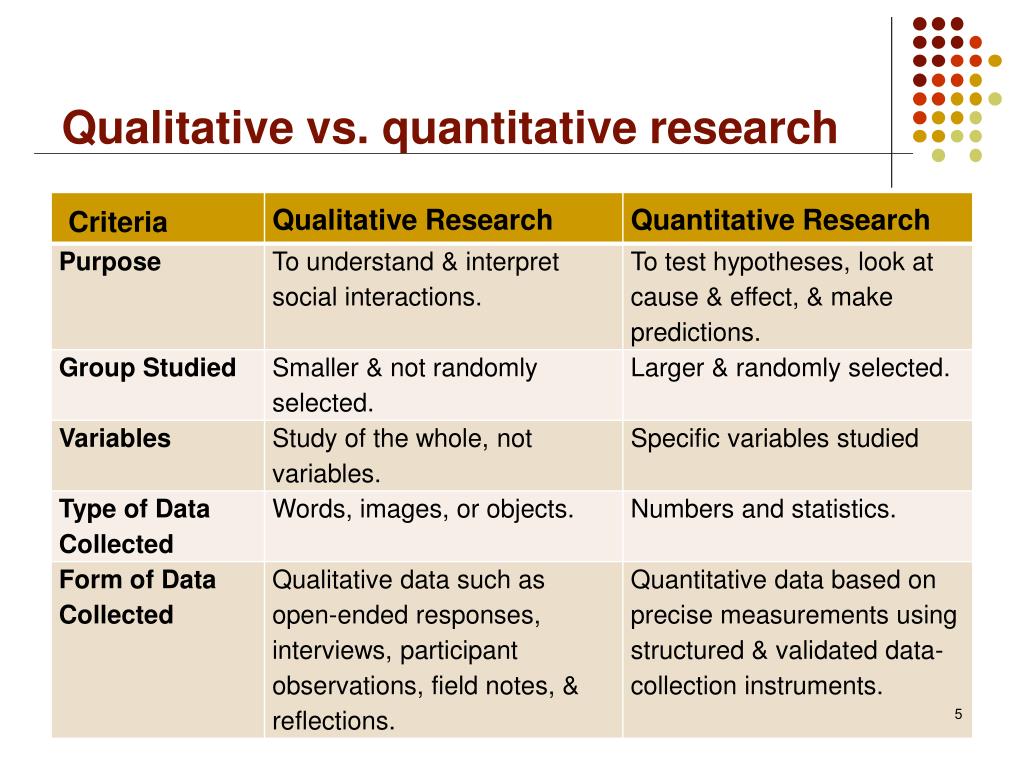
QUANTITATIVE RESEARCH
Quantitative research and qualitative research are two general categories of social research. Almost all other types of research, described above, are variations of one or the other, based on several factors such as the purpose of research, the time needed to accomplish, the environment in which research is to be conducted, or some other factor.
Quantitative research is concerned with the measurement of quantity or amount. It is applicable to all such phenomena that can be measured in terms of quantity or numbers. Quantitative research may have many goals. One purpose may be to count, how frequently something happens (e.g. the rate of divorce or rate of industrial accidents) or the patterns of occurrence of social behaviour (for example the number of persons arrested for a particular offence in a particular year). Quantitative research is concerned with describing social behaviour patters in terms of regularities. It is usually not concerned with describing why people show a certain behaviour. Quantitative research uses such methods as interviews, questionnaires or measurements and presents the results in the form of statistical tables and graphs.
Quantitative data are numerical. They are 'information about the world, in the form of numbers'. Researchers collect the relevant information and turn the data into numbers, by using measurement technique.
Measurement involves assigning numbers to things, people, events or whatever, according to particular sets of rules . Two methods are used to produce numbers counting and scaling. Counting is a common everyday Researchers measure some characteristic or property or trait of something occurrence. It is a straightforward method. Scaling is somewhat different by using a scale ranging from a great deal for perhaps 100%) of that traits, to very little (or perhaps 0%) of that trait
QUALITATIVE RESEARCH
Qualitative research aims at ascertaining opinions, attitudes, behaviour, or likes or dislikes. This type of research is concerned with describing how people feel, what they think about a certain phenomenon or what motivates them to behave in a certain way. Qualitative research essentially refers to social study based on field observations that are analysed without statistics (as opposed to a quantitative method in which a more formal and predetermined scientific approach is involved). Field research, participant observation, open-ended interviews, and focus group studies are some of the common types of qualitative research methods.
Thomas Sullivan writes that qualitative research involves collection of data in the form of words, descriptions, or narratives. When knowledge about a phenomenon is not adequate or when there is little theoretical understanding of the phenomenon, researchers usually adopt qualitative research methods. Qualitative research is more exploratory in nature and 'can be very descriptive, possibly resulting in the development of concepts and theories rather than the verification of them.
In qualitative research, the number of people, groups or communities selected are usually small, compared with survey research which covers larger populations, so that the researcher can get more details and a deeper knowledge of the variety of ways people engage with the world around them. 57 When knowledge about some phenomenon is not adequate or where there is little theoretical understanding of a phenomenon, qualitative research is considered a more appropriate method, because it may not be possible to develop precise statements of concepts or quantitative ways to measure them. In such a situation qualitative research is more exploratory
in nature. However, in many situations, qualitative research (in the sense of being exploratory here) can be very descriptive, possibly resulting in the accumulates, it may be more feasible to precisely state theories and derive testable, quantitative predictions from them.
It may be noted that both quantitative and qualitative research methods have their own benefits and disadvantages. Many research projects incorporate both approaches in order to derive the benefits of each method.
PAPER – 2023 (LLB/S-2/LLB-206/23)
Q.1(a) Hypothesis — 5 Marks
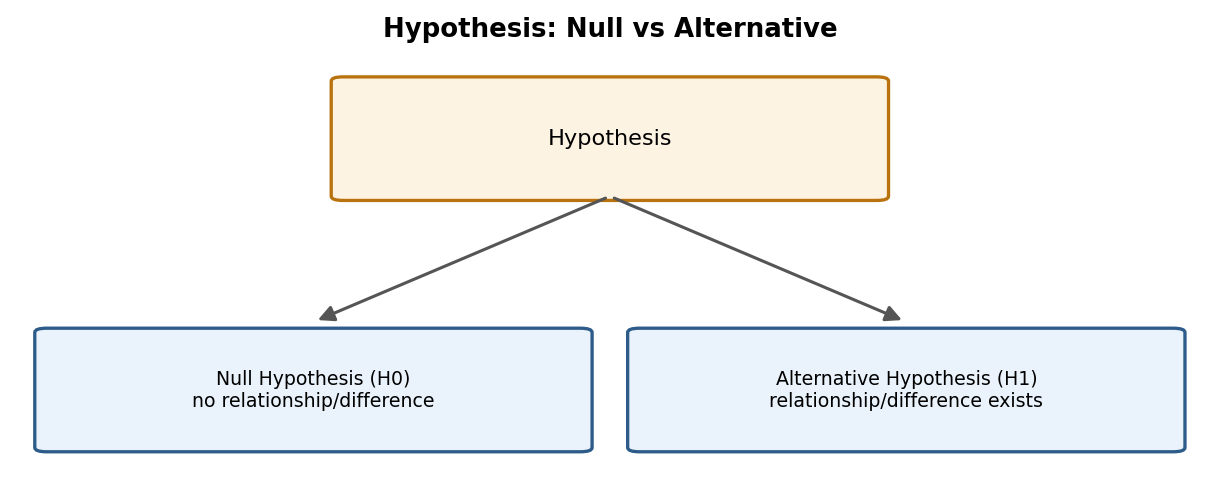
A hypothesis is a tentative, testable proposition or supposition put forward as a probable explanation of a phenomenon, formulated before actual research is undertaken and later verified or rejected through empirical investigation. In legal research it acts as a guiding thread that gives direction, focus and specificity to the study, since without a hypothesis the researcher may collect irrelevant data. A good hypothesis must be clear, specific, testable, consistent with existing knowledge and capable of empirical verification. It is generally expressed in the form of a null hypothesis (H0), which states no relationship or difference exists, and an alternative hypothesis (H1), which states a relationship or difference does exist. For example, a hypothesis in a legal study could be: 'Delay in disposal of cases increases the rate of undertrial incarceration.' The hypothesis is later confirmed, modified or rejected on the basis of the data collected.
Figure: Hypothesis
Q.1(b) Bibliography — 5 Marks
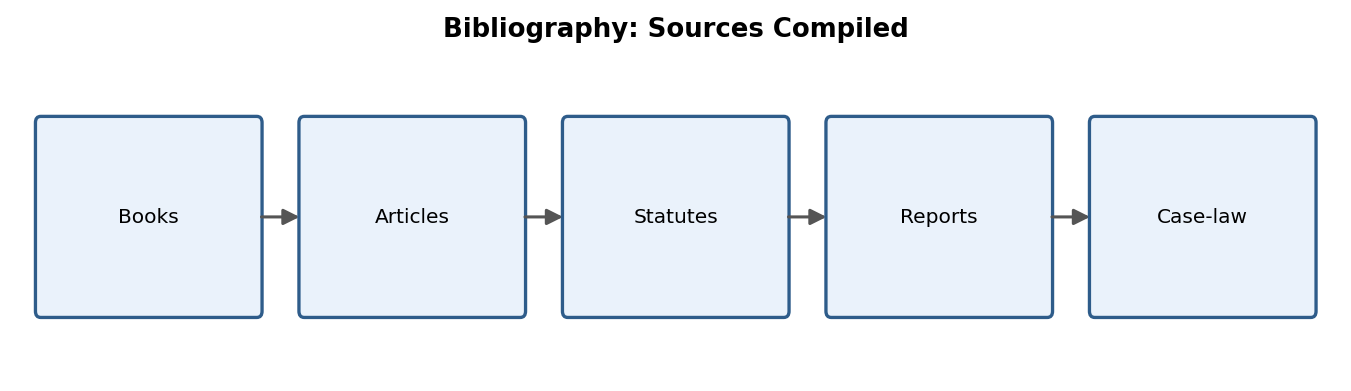
A bibliography is a systematic, alphabetically arranged list of books, articles, statutes, reports, case-law and other sources that have been consulted, referred to, or found relevant by the researcher while preparing a research work. It is generally placed at the end of a thesis, dissertation, report or article and serves several purposes: it acknowledges the intellectual debt of the author to earlier writers, enables readers to verify statements and locate original sources, and protects the researcher from allegations of plagiarism. A bibliography differs from a list of 'references' in that it may include works consulted for background even if not directly cited in the text, whereas references cite only works actually quoted or relied upon. Standard citation styles such as the Bluebook, OSCOLA or APA are commonly used in legal writing to bring uniformity to the format of author, title, publisher, year and page number.
Figure: Bibliography
Q.1(c) Data — 5 Marks
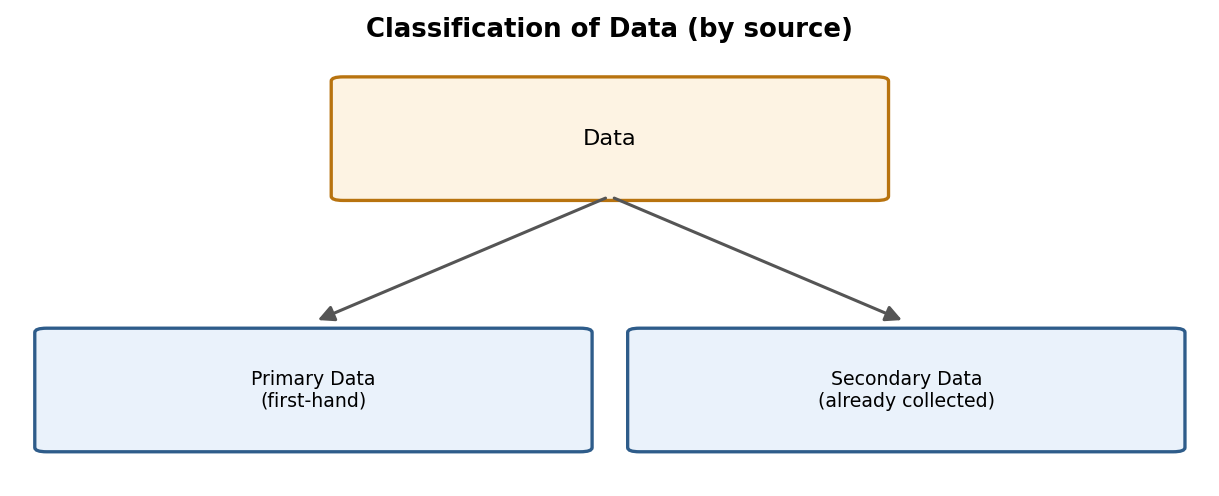
Data refers to facts, figures, observations, or information collected by a researcher which, when systematically analysed and interpreted, yield meaningful conclusions relevant to the research problem. Data may be classified broadly into primary data, which is collected first-hand by the researcher through interviews, questionnaires, schedules or observation, and secondary data, which is already collected by someone else and available in books, journals, government reports or case-law digests. Data can further be qualitative, describing characteristics and qualities, or quantitative, expressed in numerical terms and susceptible to statistical treatment. In legal research, data may include statutory provisions, judicial pronouncements, statistics on litigation, or responses gathered from lawyers, judges and litigants. The accuracy, reliability and relevance of data determine the validity of the ultimate research findings.
Figure: Data
Q.1(d) Empirical Research — 5 Marks
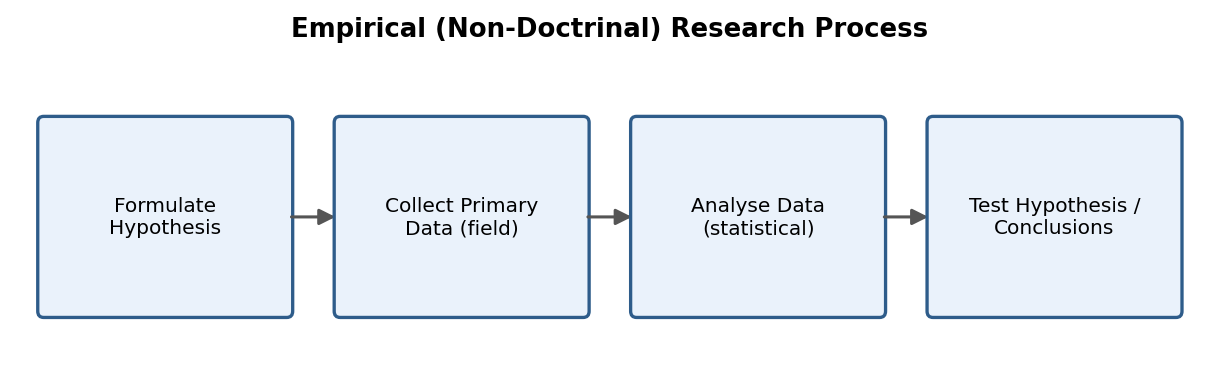
Empirical research, also called non-doctrinal or field research, is a method of inquiry that relies on direct or indirect observation and experience of real-life facts rather than on abstract legal texts alone. It seeks to study how law actually operates in society, its social impact, and the gap between the 'law in books' and the 'law in action.' The researcher collects primary data through tools such as questionnaires, interviews, schedules, case studies and observation, and then analyses this data, often using statistical techniques, to test hypotheses and arrive at conclusions. Empirical legal research is particularly valuable for policy-oriented studies, such as examining the effectiveness of a welfare legislation, because it grounds legal analysis in verifiable social reality rather than in purely conceptual or textual reasoning.
Figure: Empirical Research
Q.1(e) Case Study — 5 Marks
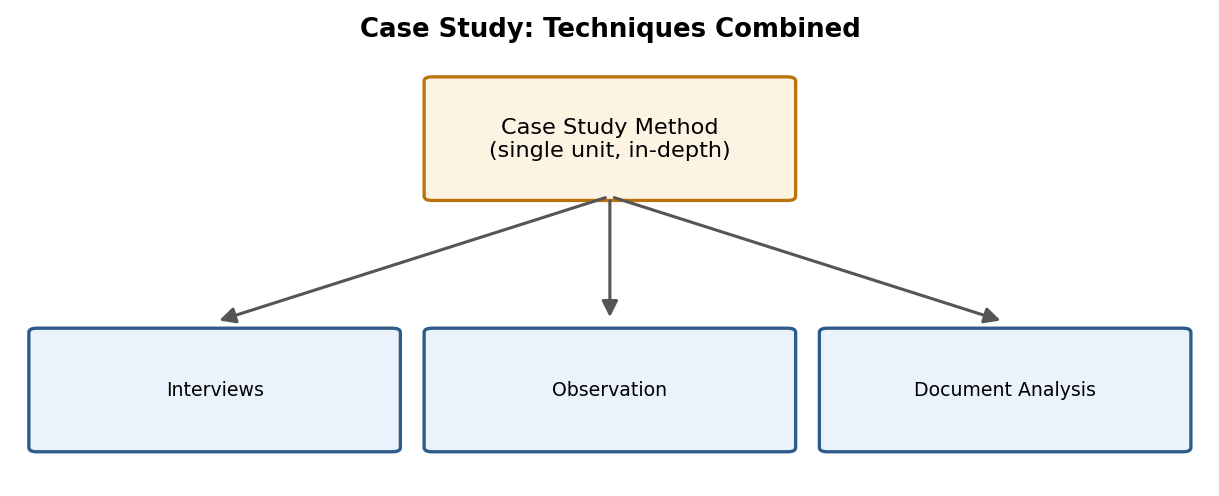
The case study method is an intensive, in-depth investigation of a single unit—an individual, institution, community, event or a particular legal dispute—undertaken to understand it comprehensively in its natural context. It aims at a detailed and holistic understanding of the unit by examining its history, background, present condition and the interrelationship of the various factors affecting it. In legal research, case studies are often used to examine, for instance, how a particular piece of legislation has been implemented in a locality, or how a landmark judgment has affected a specific community. The method typically employs multiple techniques together—interviews, document analysis and observation—to build a rich, contextual picture, though its findings, being confined to one unit, cannot easily be generalised to the wider population.
Figure: Case Study
Q.1(f) Report — 5 Marks
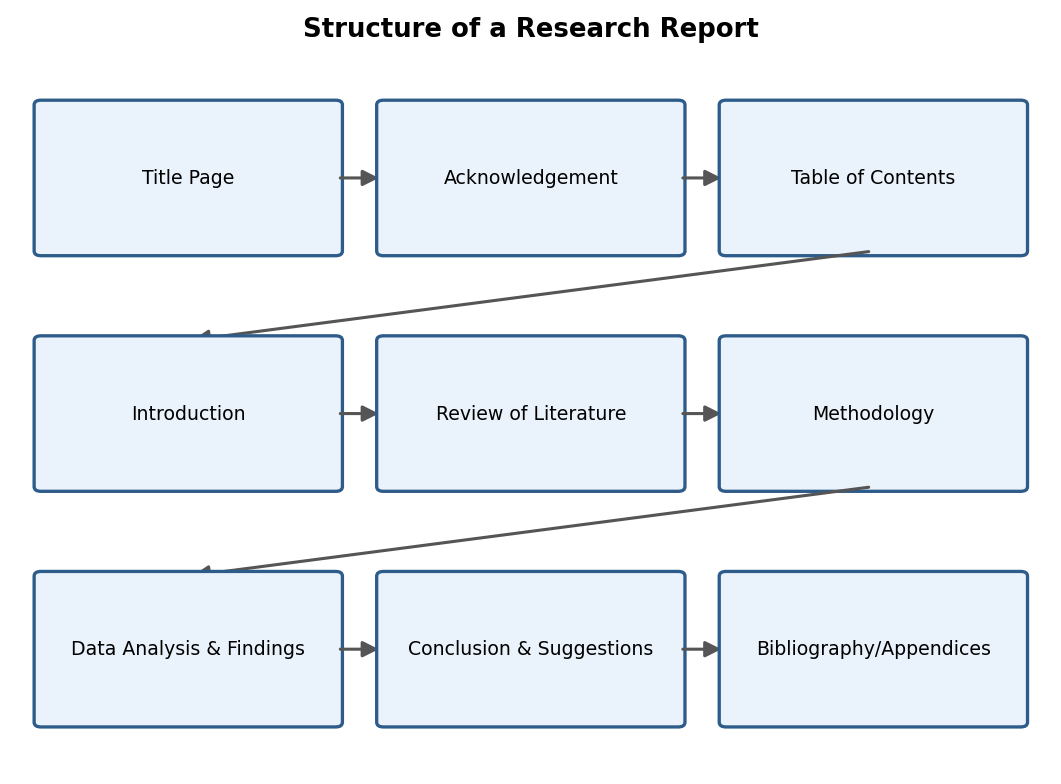
A research report is the final, formal written presentation of the findings, analysis and conclusions of a research study, communicated in a systematic and organised manner so that readers can understand the problem investigated, the methodology adopted and the results obtained. A good report generally follows a structure comprising a title page, acknowledgement, table of contents, introduction stating the problem and objectives, review of literature, research methodology, data analysis and findings, conclusions and suggestions, and a bibliography or appendices. The characteristics of a good report include clarity, conciseness, logical sequencing, objectivity, accuracy of facts, and freedom from bias. In legal research, the report communicates the researcher's contribution to legal knowledge or policy and must be written in simple, precise language avoiding unnecessary jargon.
Figure: Report Structure
Q.1(g) Interview — 5 Marks
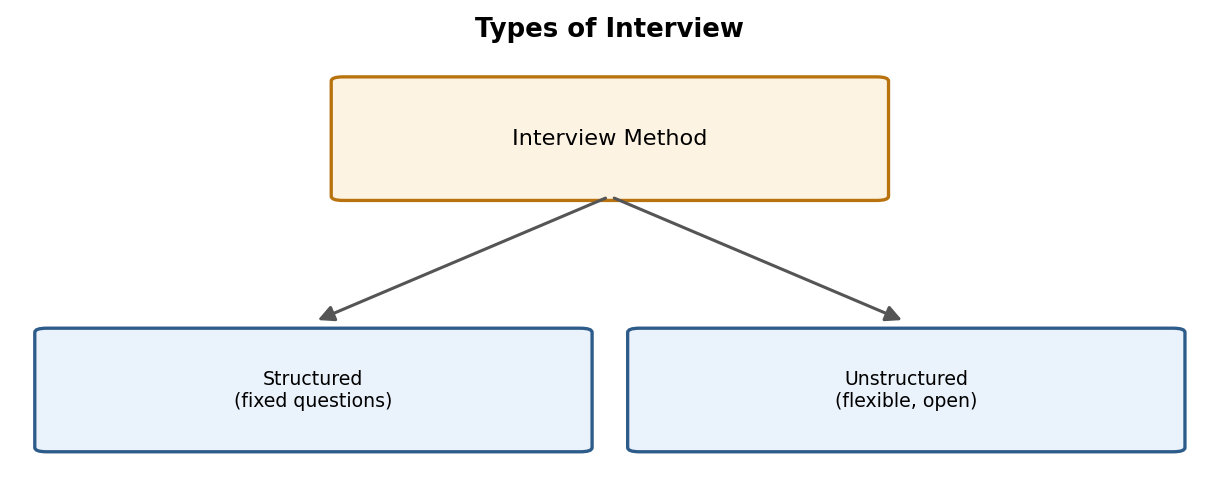
An interview is a face-to-face or telephonic/virtual method of primary data collection in which the researcher (interviewer) puts questions orally to the respondent (interviewee) and records the answers. It may be structured, where a fixed set of questions is asked in a predetermined order, or unstructured, where the interviewer has freedom to frame and sequence questions flexibly according to the flow of conversation. The interview method has the advantage of allowing the researcher to clarify doubts, probe deeper into answers, observe non-verbal cues and obtain a high response rate; however, it can be time-consuming, costly, and susceptible to interviewer bias. In legal research, interviews are frequently used to gather the opinions and experiences of judges, lawyers, litigants, police officers or victims regarding the functioning of law.
Figure: Interview
Q.1(h) Citation — 5 Marks
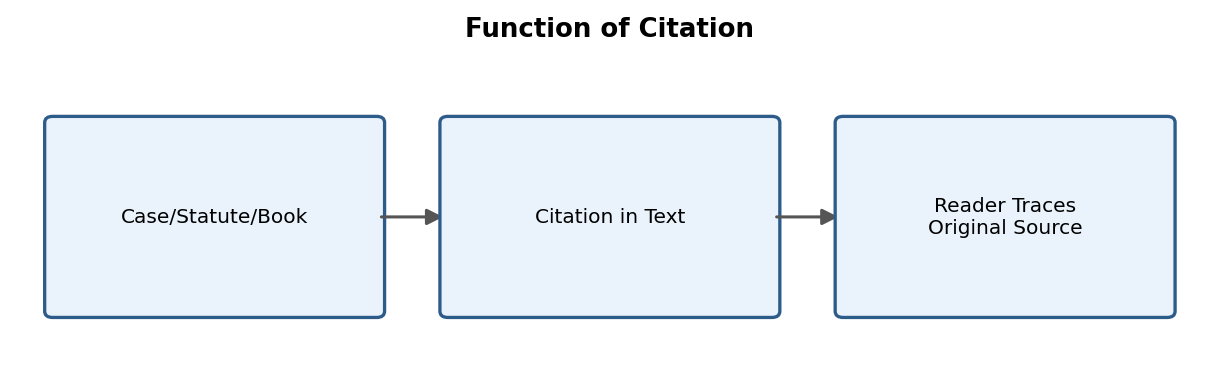
Citation is the formal and standardised acknowledgment, within a piece of legal writing, of the source from which a proposition, quotation, fact or argument has been drawn, such as a case, statute, book or article. Proper citation enables a reader to trace and verify the original authority, lends credibility to the writer's arguments, and is an essential safeguard against plagiarism. In legal writing, citation of case-law generally follows a set pattern giving the parties' names, year, volume, law report abbreviation and page or citation number (for example, the neutral citation or a report like AIR or SCC), while citation of statutes gives the short title, year and relevant section. Uniform citation systems such as the Bluebook, OSCOLA or the Indian Law Institute style are commonly followed to maintain consistency across legal scholarship.
Figure: Citation
Q.1(i) Primary Sources — 5 Marks
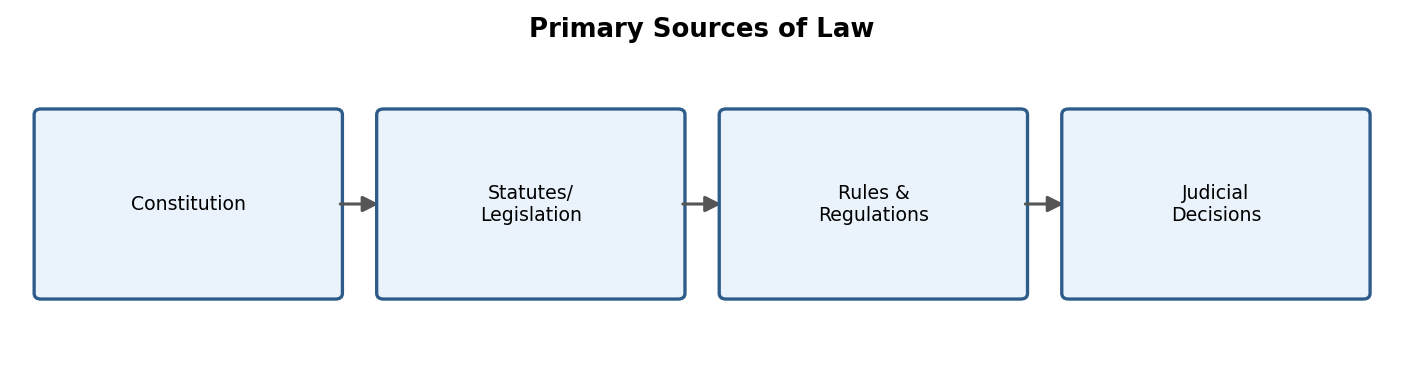
Primary sources in legal research are original, first-hand materials that constitute the law itself or first-hand data generated directly by the researcher, as opposed to sources that merely comment upon or analyse the law. Examples include the Constitution, statutes and enacted legislation, statutory rules and regulations, and judicial decisions/case-law, all of which are authoritative and binding sources of law. In the empirical sense, primary sources also include first-hand data collected by the researcher through questionnaires, interviews, schedules and observation. Primary sources are distinguished from secondary sources such as textbooks, commentaries, law journal articles and digests, which interpret, explain or critique the primary material. Reliance on primary sources is essential in legal research because they represent the actual, authoritative statement of the law rather than someone else's interpretation of it.
Figure: Primary Sources
Q.1(j) Questionnaire — 5 Marks
A questionnaire is a structured research instrument consisting of a set of written questions, along with the possible response formats, which is administered to respondents either in person, by post, or electronically, and which they answer themselves without the presence of the researcher. Questions may be open-ended, allowing free responses, or closed-ended, offering fixed choices such as multiple-choice or yes/no answers, and are usually arranged in a logical sequence moving from simple to more complex issues. The questionnaire method is economical, can cover a large and geographically dispersed sample, ensures anonymity that may encourage frank answers, and produces data that is relatively easy to tabulate; however, it suffers from low response rates, the risk of ambiguous or misunderstood questions, and the impossibility of clarifying doubts, since no interviewer is present.
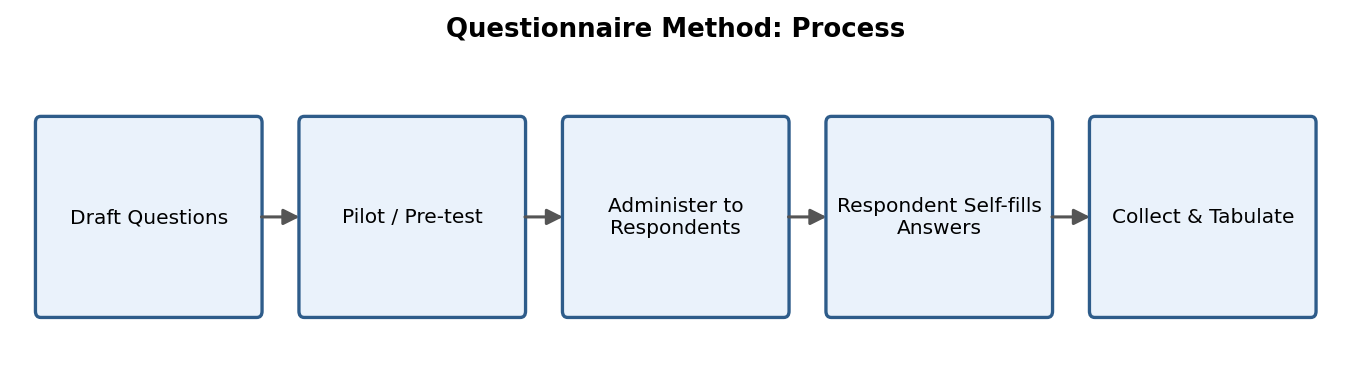
Figure: Questionnaire
Q.2 Concept of Legal Research and Steps of Conducting Legal Research — 5+5 = 10 Marks
(a) Concept of Legal Research: Legal research is a systematic, scientific process of investigation directed towards the discovery, ascertainment, clarification, or development of legal principles, doctrines, rules and their operation in society. It involves identifying a legal problem, locating and analysing statutes, case-law, and juristic writings, and drawing conclusions that either restate existing law, resolve ambiguity, or suggest reform. Legal research may be doctrinal, confined to the study of legal texts and precedents (the 'law in books'), or non-doctrinal/empirical, examining the social operation and impact of law (the 'law in action'). Its objectives include ascertaining the existing state of law, testing the validity of legal propositions, evaluating the adequacy of law to meet social needs, and generating recommendations for legislative or judicial reform.
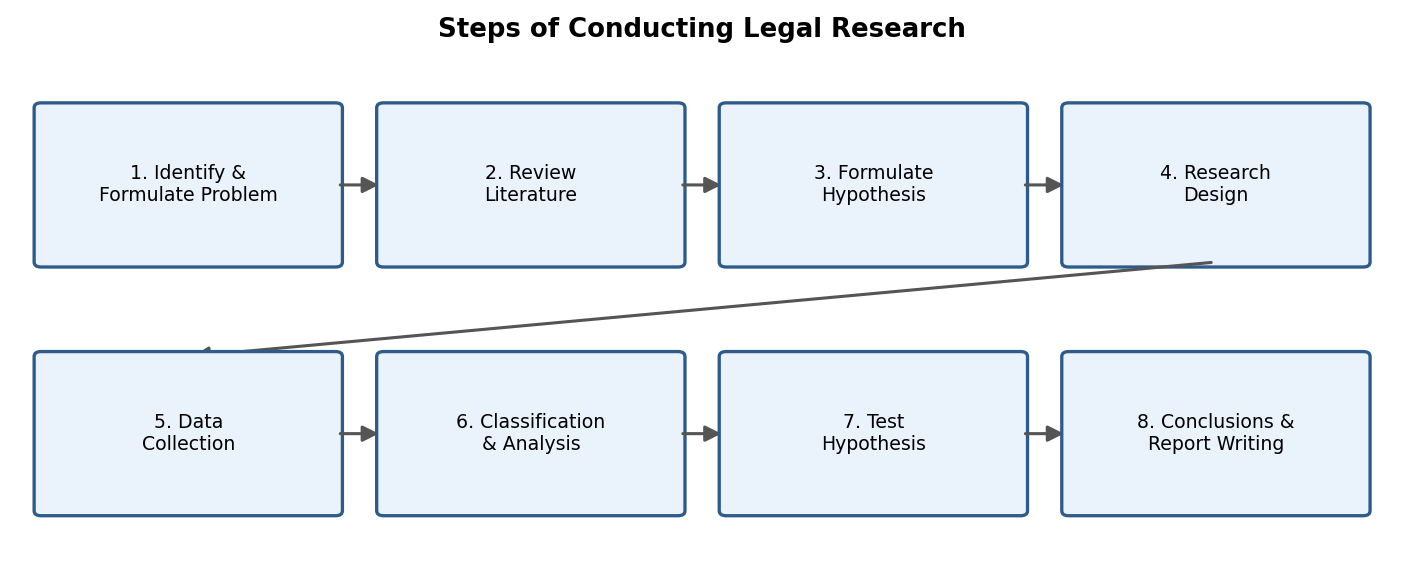
(b) Steps of Conducting Legal Research: The process generally proceeds through the following stages: (i) identification and formulation of the research problem, which must be specific and manageable — a vague topic such as 'problems of the judiciary' must be narrowed to something researchable, such as 'causes of delay in disposal of civil suits in district courts of a given region'; (ii) review of existing literature, including textbooks, journal articles, government and Law Commission reports, and prior case-law, to understand what has already been written on the subject, to avoid unnecessary duplication, and to identify gaps that the present study can fill; (iii) formulation of a hypothesis or specific research questions/objectives that the study will test or explore, giving the research a clear direction; (iv) preparation of a research design, deciding whether the study will be doctrinal, non-doctrinal/empirical, or a combination of both, identifying the population and sample (if empirical), and choosing appropriate tools of data collection such as questionnaires, interviews or case studies; (v) actual collection of data from primary sources (statutes, case-law, field data) and secondary sources (books, reports, statistics); (vi) classification, tabulation, and analysis of the data collected, often using statistical techniques for quantitative data and interpretative/content analysis for qualitative and doctrinal material; (vii) testing of the hypothesis in light of the findings, determining whether it stands confirmed, needs modification, or must be rejected; and (viii) drawing conclusions and, finally, writing up the research report in a systematic, well-referenced and coherent manner, including practical suggestions for legislative, judicial or policy reform where the findings warrant it.
Each of these steps is interlinked, and legal research is rarely a strictly linear process — the researcher often has to revisit an earlier stage, for instance refining the hypothesis after a preliminary literature review, or narrowing the research design after a pilot study reveals practical difficulties in data collection. This iterative character is what distinguishes rigorous academic legal research from a mere descriptive survey of the law, since it demands that every stage feed critically into the next in the pursuit of a reliable and defensible conclusion.
Figure: Steps Legal Research
Q.3 Advantages and Limitations of Doctrinal Research — 10 Marks
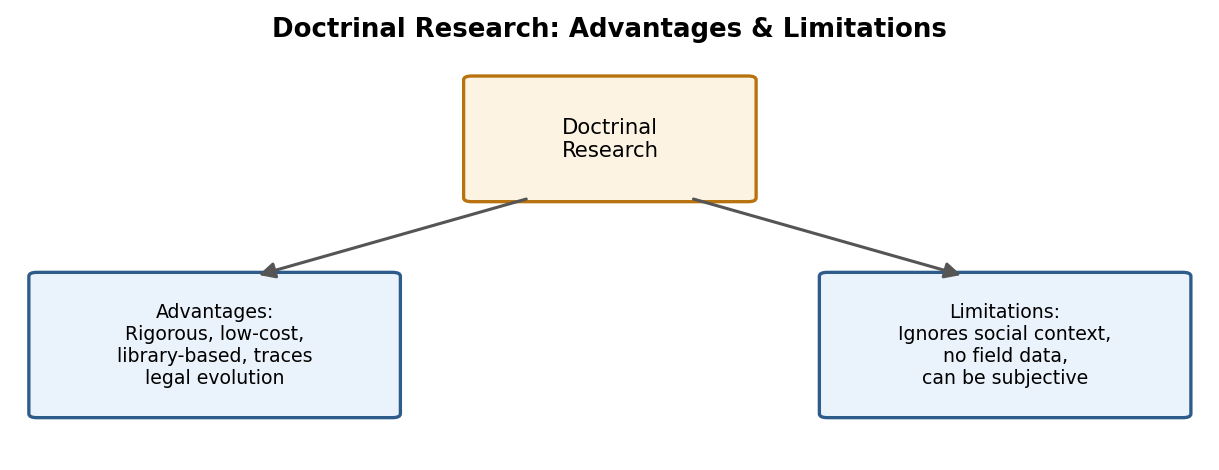
Doctrinal research, also called 'black-letter law' research, is the traditional method of legal research confined to the systematic analysis of statutory provisions and judicial decisions, together with the application of reasoning to identify, formulate and refine legal principles. Its advantages are numerous: it provides a rigorous, logically coherent understanding of legal rules and doctrines; it is comparatively inexpensive and can be conducted using library resources without the need for field surveys; it enables the researcher to trace the historical evolution of a legal principle through statutes and case-law; it is indispensable for practitioners, judges and students who need a precise statement of 'what the law is'; and it forms the necessary foundation upon which even empirical legal studies are built, since one must first know the law before studying its social effects.
However, doctrinal research also has notable limitations. It tends to be confined to an analysis of legal texts in isolation from their social context, and therefore may fail to reveal how law actually operates in practice or whether it achieves its intended social purpose. It can become overly formalistic and abstract, disconnected from the lived experience of those affected by the law. It does not employ empirical tools such as surveys or interviews and therefore cannot measure the practical impact, efficacy, or public perception of a legal rule. Because it relies heavily on the researcher's personal interpretation of authorities, it can also be criticised for subjectivity. Consequently, doctrinal research is often regarded as necessary but not sufficient, and is best complemented by non-doctrinal, empirical research for a fuller understanding of law in society.
An illustration makes the point clear: a doctrinal study of the anti-dowry provisions of the Indian Penal Code can precisely state the ingredients of the offence, the burden and standard of proof, and the manner in which courts have interpreted the presumption under the Evidence Act, drawing on a coherent body of case-law. What such a study cannot tell us, however, is whether the provision is actually invoked by victims, whether police are willing to register complaints, or whether convictions translate into any real deterrent effect — questions that only field-based, non-doctrinal research involving victims, police officers and court records can answer. This is why leading law commissions and academic bodies increasingly insist on a 'law-in-context' approach that begins with rigorous doctrinal analysis of the black-letter rule but then subjects that rule to empirical scrutiny before recommending reform, since a purely textual critique risks proposing solutions to a problem that, in practice, may not exist in the form assumed, or may exist for reasons the text alone cannot reveal.
Figure: Doctrinal Adv Lim
Q.4 Non-Doctrinal Research and Its Methods — 10 Marks
Non-doctrinal research, also known as empirical or socio-legal research, is that branch of legal research which studies law not merely as a body of rules but as a living social institution, examining how law operates in actual practice, its causes, effects and interaction with society. It seeks to bridge the gap between 'law in books' and 'law in action' by generating first-hand data about the behaviour of legal institutions, litigants, lawyers, and the general public.
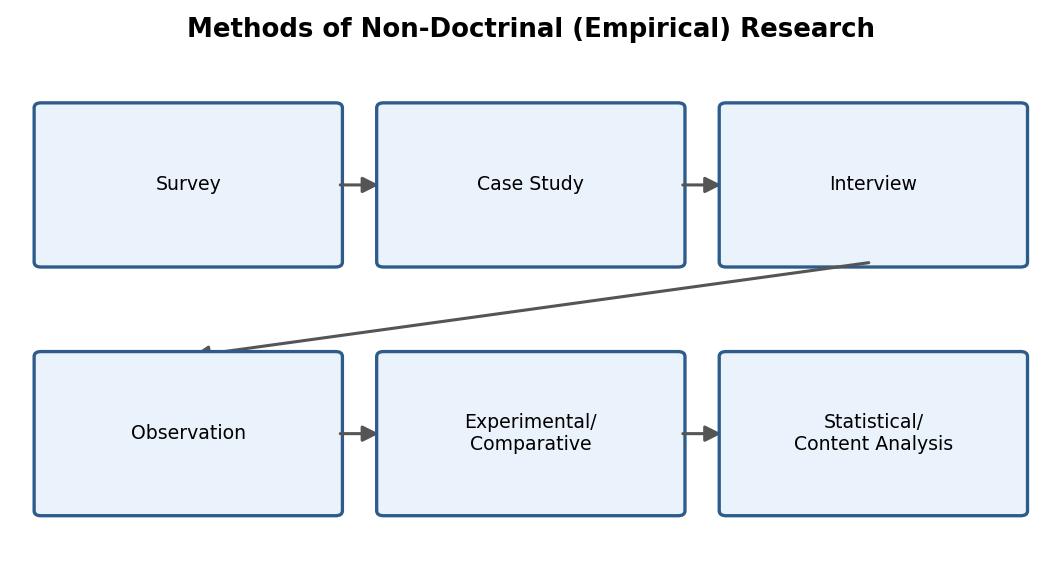
The principal methods employed in non-doctrinal research include: (i) the survey method, involving the systematic collection of data from a sample of respondents through questionnaires or schedules to study attitudes, opinions or the incidence of a phenomenon across a population; (ii) the case study method, involving an intensive, in-depth study of a single unit such as an individual, institution or community; (iii) the interview method, both structured and unstructured, for eliciting detailed qualitative information; (iv) the observation method, where the researcher directly watches and records behaviour, whether as a participant or non-participant observer, for example in a court room; (v) experimental and comparative methods, occasionally used to compare legal outcomes across jurisdictions or before-and-after a legislative change; and (vi) statistical and content-analysis methods for processing quantitative or documentary data such as court records. These tools enable the researcher to test the effectiveness of a law, assess public awareness of legal rights, or evaluate the functioning of a legal institution.
To illustrate, a researcher studying the effectiveness of the Protection of Women from Domestic Violence Act would first need to know, doctrinally, what reliefs the Act provides; but to know whether the Act is actually working, the researcher would have to use non-doctrinal tools — interviewing Protection Officers about their case-load and constraints, surveying magistrates on the time typically taken to grant interim relief, observing proceedings in family courts, and examining case-file records to determine what proportion of applications actually result in an enforceable order. Because such research deals with human respondents, it must also observe basic ethical safeguards, including informed consent, voluntary participation, confidentiality of identity (particularly important in matters involving domestic violence or sexual offences), and, where the study is institutional, prior permission from the concerned authority. The value of non-doctrinal research lies precisely in its capacity to expose such practical realities, which a purely textual reading of the statute would never reveal.
Figure: Nondoctrinal Methods
Q.5 Comparison Between Doctrinal and Non-Doctrinal Research — 10 Marks
Doctrinal and non-doctrinal research differ fundamentally in their focus, method and purpose, though both are complementary branches of legal research. Doctrinal research, sometimes called 'library-based' or 'black-letter' research, confines itself to the analysis of legal texts—statutes, case-law, and juristic commentary—using logical and analytical reasoning to state, systematise and critique 'the law as it is.' Non-doctrinal research, by contrast, studies the social reality and operation of law using empirical tools of data collection, focusing on 'law in action' and its effects on society.
In terms of sources, doctrinal research relies on primary legal sources such as legislation and judgments together with secondary juristic literature, whereas non-doctrinal research relies on first-hand field data gathered through surveys, interviews, case studies and observation. In terms of method, doctrinal research is analytical and interpretative, while non-doctrinal research is empirical and often statistical. In terms of cost and time, doctrinal research is comparatively quicker and less expensive since it can be conducted in a library, whereas non-doctrinal research is generally more time-consuming, resource-intensive and requires field work and, sometimes, ethical clearance for dealing with human subjects. In terms of output, doctrinal research typically produces a restatement, clarification or critique of legal doctrine, while non-doctrinal research produces findings about the social impact, efficacy or perception of law, often accompanied by policy recommendations. The two approaches are not mutually exclusive; the most robust legal research typically combines a sound doctrinal understanding of the law with empirical verification of its actual operation in society.
The following points of comparison summarise the distinction: (i) Focus — doctrinal research focuses on 'what the law is'; non-doctrinal research focuses on 'how the law works.' (ii) Data — doctrinal research uses statutes, judgments and juristic writing; non-doctrinal research uses first-hand field data. (iii) Method — doctrinal research is analytical/interpretative; non-doctrinal research is empirical, often statistical. (iv) Setting — doctrinal research is largely library-based; non-doctrinal research requires field work, sampling and, frequently, institutional access or ethical clearance. (v) Output — doctrinal research yields a restatement or critique of legal doctrine; non-doctrinal research yields findings on social impact, efficacy and public perception, generally accompanied by policy recommendations. Neither approach, in isolation, gives a complete picture of law; contemporary legal scholarship, particularly work commissioned by law reform bodies, increasingly demands a combined doctrinal-cum-empirical study before recommending legislative change.
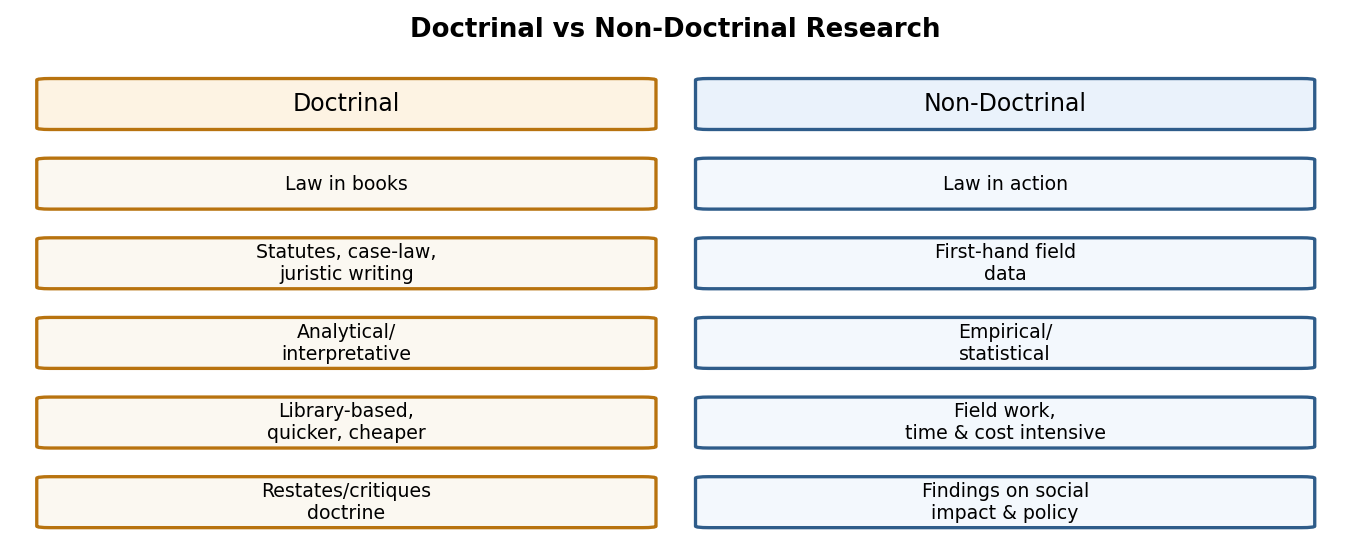
Figure: Doctrinal Vs Nondoctrinal
UNIT-III
Answer any one of the following (20 marks) — both answered below
Q.6 Sources and Tools of Data Collection — 10+10 = 20 Marks
(a) Sources of Data Collection: Data used in legal research is drawn from two broad sources. Primary sources are those from which the researcher gathers first-hand, original data directly relevant to the specific study, such as respondents interviewed, questionnaires filled by litigants or lawyers, court records personally examined, or events personally observed by the researcher; this data has not been processed or interpreted by anyone else before. Secondary sources, on the other hand, consist of data that has already been collected, compiled, and published by some other person or agency for a purpose other than the present study, such as government reports, census data, NCRB crime statistics, law commission reports, published judgments, books, journal articles and newspaper archives. Legal researchers typically use secondary sources for background and context and primary sources to generate original findings specific to their research problem.
(b) Tools of Data Collection: The principal tools used to gather primary data include: (i) the questionnaire, a self-administered structured instrument of written questions; (ii) the schedule, similar to a questionnaire but filled in by the investigator/enumerator on behalf of the respondent, which is useful where respondents are illiterate; (iii) the interview, structured or unstructured, involving direct oral questioning; (iv) observation, whereby the researcher watches and records behaviour or events as they occur, either as a participant or a non-participant; (v) case studies, involving in-depth examination of a single unit; and (vi) documentary/content analysis, involving systematic examination of official records, case files, or archival material. The choice of tool depends on the nature of the research problem, the characteristics of the respondents, the time and resources available, and the type of data (qualitative or quantitative) required.
A composite example illustrates how sources and tools work together in practice: suppose a researcher wishes to study the effectiveness of the National Legal Services Authority's legal aid scheme in a particular state. The primary sources of data would include personal interviews with beneficiaries who availed legal aid, questionnaires administered to empanelled legal aid counsel, and direct observation of Lok Adalat proceedings; the secondary sources would include NALSA's own annual reports, state legal services authority statistics, and academic literature evaluating legal aid schemes elsewhere. In terms of tools, the researcher might use a structured questionnaire for literate beneficiaries residing in urban areas, but switch to a schedule administered by trained field investigators for illiterate beneficiaries in rural areas; unstructured interviews might be used with legal aid counsel to elicit candid, in-depth views on systemic obstacles that a structured instrument would not capture; and documentary analysis of case files would supply objective, verifiable data on disposal rates and time taken, which is less susceptible to the subjective bias that can affect interview-based data. This layered use of multiple sources and tools, rather than reliance on any single one, is what gives empirical legal research its rigour, since triangulating findings across different methods allows the researcher to cross-verify results and identify any distortion introduced by a particular tool or source.
Figure: Sources Tools Data Collection
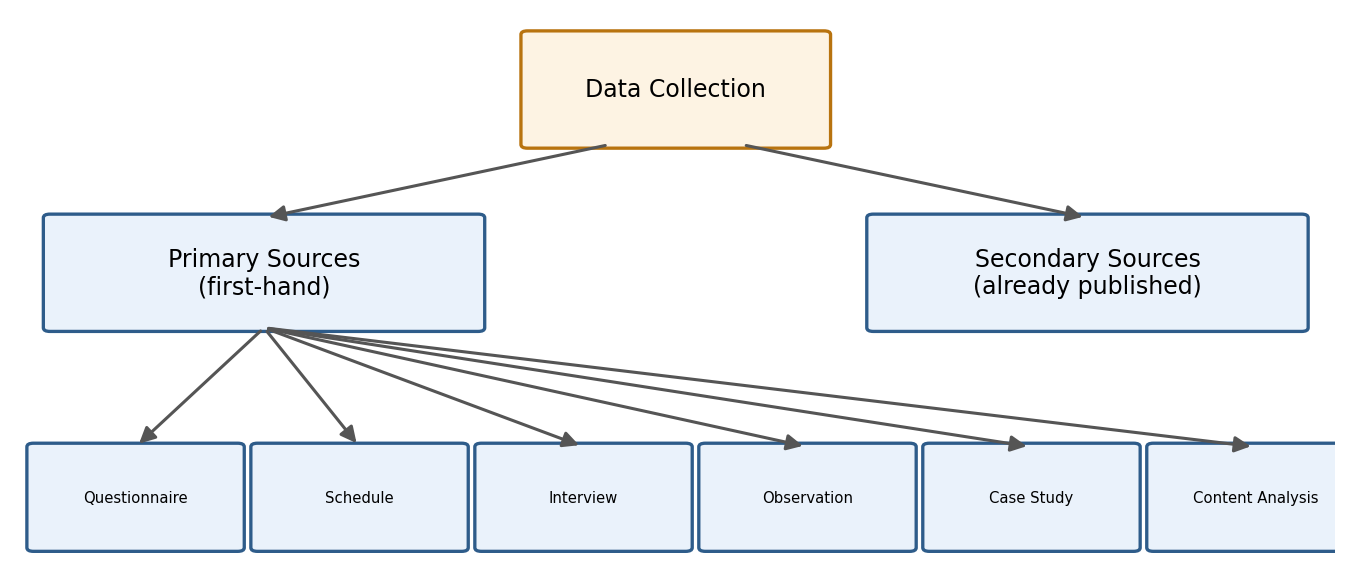
Q.7 Inductive vs Deductive Research; Methods of Research — 8+12 = 20 Marks
(a) Distinction Between Inductive and Deductive Research: Inductive research is a method of reasoning that proceeds from specific observations or particular instances to arrive at general conclusions or theories; the researcher collects data first and then formulates a hypothesis or generalisation based on the patterns observed, moving from the particular to the general. Deductive research, on the other hand, begins with a general theory, principle or hypothesis, which is then tested against specific facts or data to confirm or refute it, moving from the general to the particular. In legal research, an inductive approach might involve studying a series of individual judgments on a point of law to derive a general principle, whereas a deductive approach might start from an established legal doctrine and test whether it correctly explains or predicts the outcome of specific cases. Inductive reasoning is exploratory and theory-building, while deductive reasoning is confirmatory and theory-testing; the two approaches are often used together in a cyclical manner in comprehensive research.
(b) Various Methods of Research: Research methods may be classified in several ways. On the basis of purpose, research may be descriptive (describing characteristics of a phenomenon), analytical (critically examining existing information), exploratory (investigating a relatively unexamined problem), or explanatory (establishing cause-and-effect relationships). On the basis of approach, research may be qualitative, focusing on non-numerical, descriptive data such as opinions and experiences, or quantitative, focusing on numerical data subjected to statistical analysis; increasingly, mixed-method research combines both. In terms of legal research specifically, the two principal methods are the doctrinal method, involving analysis of statutes and case-law, and the non-doctrinal/empirical method, employing surveys, interviews, case studies and observation. Other specific methods include the historical method, tracing the evolution of a legal institution over time; the comparative method, examining law across different jurisdictions to draw lessons for reform; and the socio-legal method, situating law within its broader social, economic and political context. The choice of method depends upon the nature of the research problem, the objectives of the study, and the resources available to the researcher.
To illustrate the inductive-deductive distinction further: if a researcher, without any prior theory, examines fifty judgments on anticipatory bail and notices a recurring pattern that courts tend to grant bail more readily where the accused has no previous criminal record, and from this pattern formulates the general proposition that 'clean antecedents significantly increase the likelihood of anticipatory bail being granted,' this is inductive reasoning — moving from particular observations to a general conclusion. If, conversely, the researcher begins with the established legal principle (drawn from Gurbaksh Singh Sibbia) that anticipatory bail should not ordinarily be fettered by rigid conditions, and then tests, against a fresh set of judgments, whether courts are in fact adhering to this settled principle or departing from it, this is deductive reasoning — testing a general proposition against specific facts. Most rigorous legal research actually alternates between the two: an inductive phase generates a working hypothesis from an initial body of cases or data, and a subsequent deductive phase tests that hypothesis against a fresh, independent set of cases or data to check whether the generalisation genuinely holds, a process sometimes described as the 'hypothetico-deductive' method. Recognising which mode of reasoning a particular research question calls for helps the researcher avoid the common error of treating a handful of illustrative cases as though they conclusively proved a general rule, when in truth a properly designed, larger-scale study would be required to establish the proposition with confidence.
Figure: Inductive
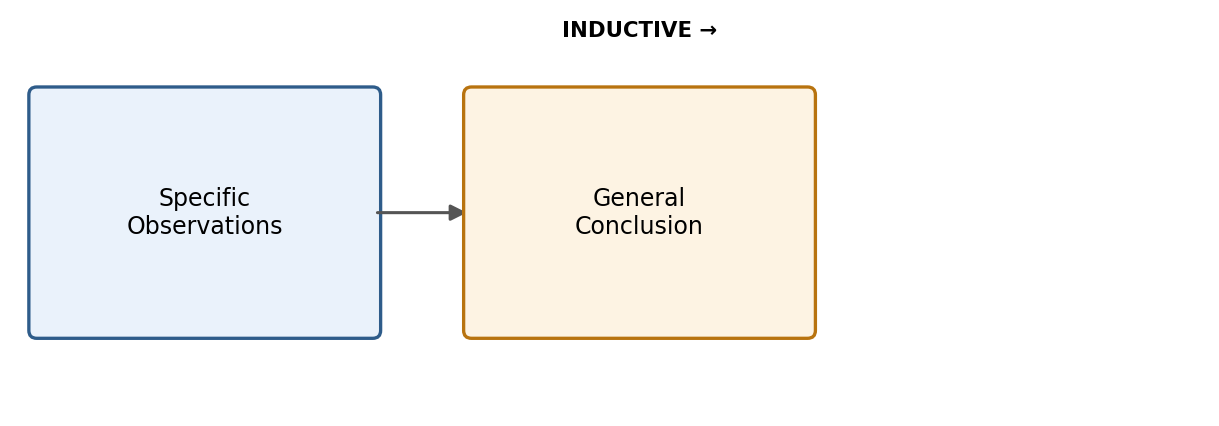
Figure: Deductive
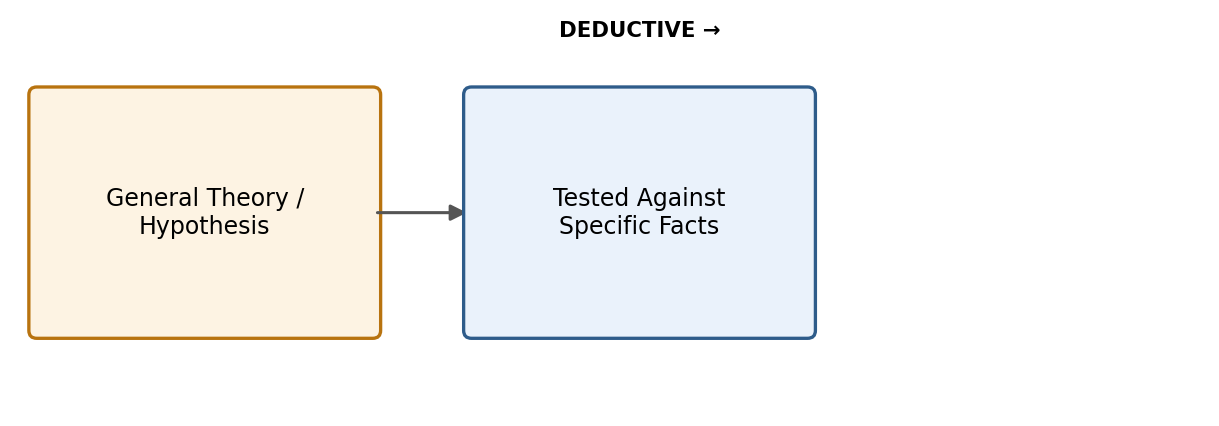
Figure: Methods Classification
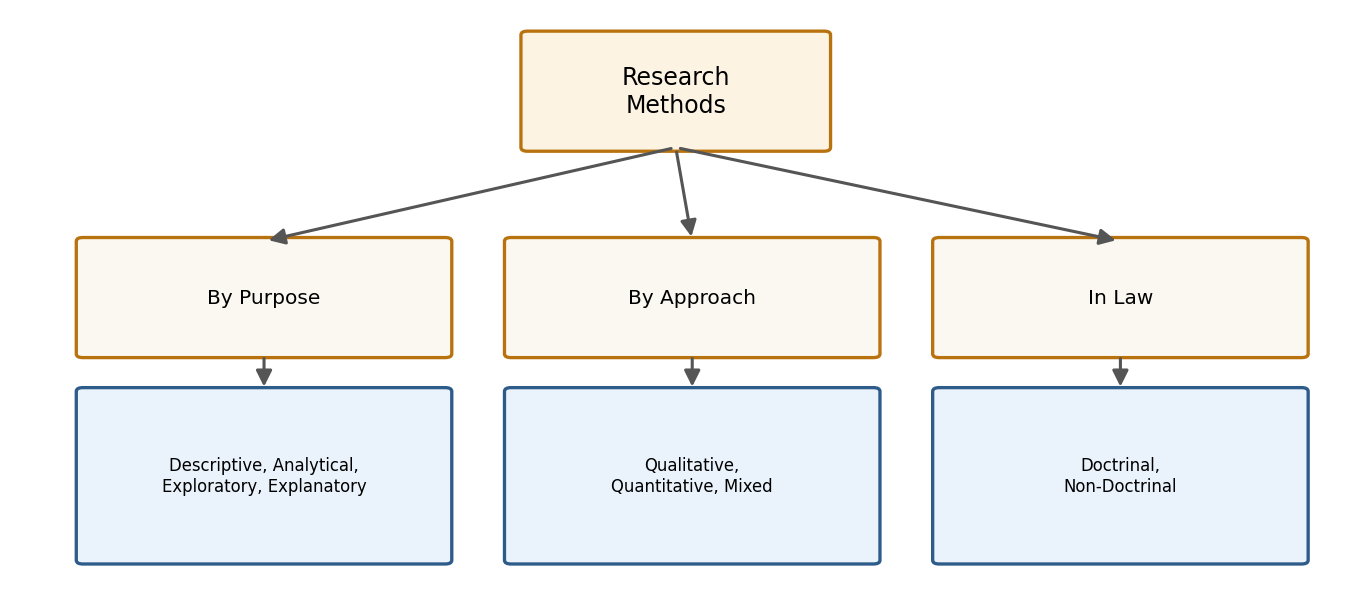
PAPER – 2024 (LLB/S-2/LLB-206/24)
Q.1(a) Concept of Legal Research — 5 Marks
Legal research is the systematic and scientific process of identifying, locating, analysing and applying legal materials—statutes, case-law, and juristic writings—in order to ascertain, clarify, restate or critically evaluate the law on a given point, or to study its social operation and effect. It is not confined merely to 'finding the law' but extends to the critical and analytical examination of existing legal rules to test their consistency, adequacy and fairness, and, where necessary, to propose reform. Legal research may be doctrinal, which studies 'law in books,' or non-doctrinal/empirical, which studies 'law in action' and its social impact. It serves practitioners in building arguments, judges in deciding cases, legislators in drafting and reforming laws, and academics in advancing legal knowledge, making it a foundational skill for the legal profession.
Figure: Steps Legal Research
Q.1(b) Different Types of Research — 5 Marks
Research can be classified on several bases. On the basis of purpose: descriptive research describes existing conditions; analytical research critically evaluates already available information; and exploratory research investigates a relatively new field. On the basis of approach: quantitative research deals with numerical data amenable to statistical treatment, while qualitative research deals with non-numerical descriptions of qualities, opinions and experiences. On the basis of application: fundamental (pure) research aims at generating knowledge for its own sake, while applied research aims at solving a specific practical problem. In law specifically, the most important classification is between doctrinal research, confined to legal texts, and non-doctrinal/empirical research, which studies the social functioning of law using field-based tools. Other types include historical, comparative and evaluative research.
Figure: Methods Classification
Q.1(c) Sample Design — 5 Marks
Sample design refers to the definite plan, determined before data is actually collected, for obtaining a sample from a given population. Since it is often impractical to study an entire population, a researcher selects a representative subset (the sample) using a scientific procedure so that conclusions drawn from the sample can be validly generalised to the whole population. A good sample design must ensure representativeness, adequacy of sample size, and minimal sampling error. Sample designs are broadly divided into probability sampling, where every unit of the population has a known, non-zero chance of selection (e.g., simple random, stratified, systematic, or cluster sampling), and non-probability sampling, where units are selected on the basis of the researcher's judgment or convenience (e.g., purposive, convenience, or quota sampling). The choice of design depends on the nature of the population, the objectives of the study, and available resources.
Figure: Sample Design
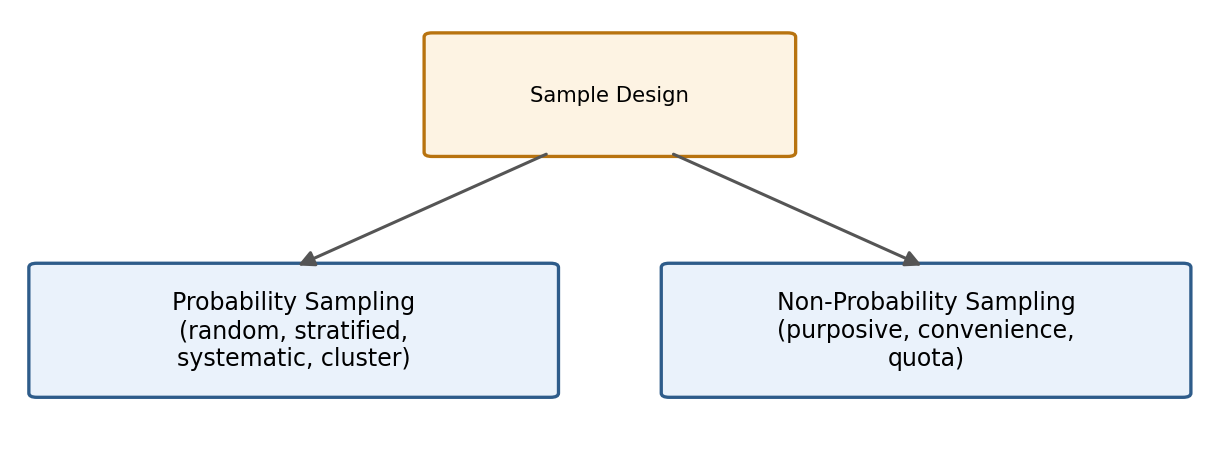
Q.1(d) Research Method vs Research Methodology — 5 Marks
Research method refers to the specific techniques or tools used by a researcher to collect and analyse data, such as the survey method, interview method, observation method, or statistical method; it is concerned with the actual operations or procedures adopted in the course of research. Research methodology, on the other hand, is a broader concept referring to the systematic, theoretical analysis of the methods applied to a field of study; it explains and justifies why a particular method was chosen, and encompasses the underlying logic, philosophy, and rationale of the research process as a whole, including problem formulation, hypothesis construction, and the theoretical framework guiding data collection and analysis. In short, method is the 'how' of data collection, whereas methodology is the overall 'science' or logic of conducting research, of which method is only one component.
Figure: Method Vs Methodology
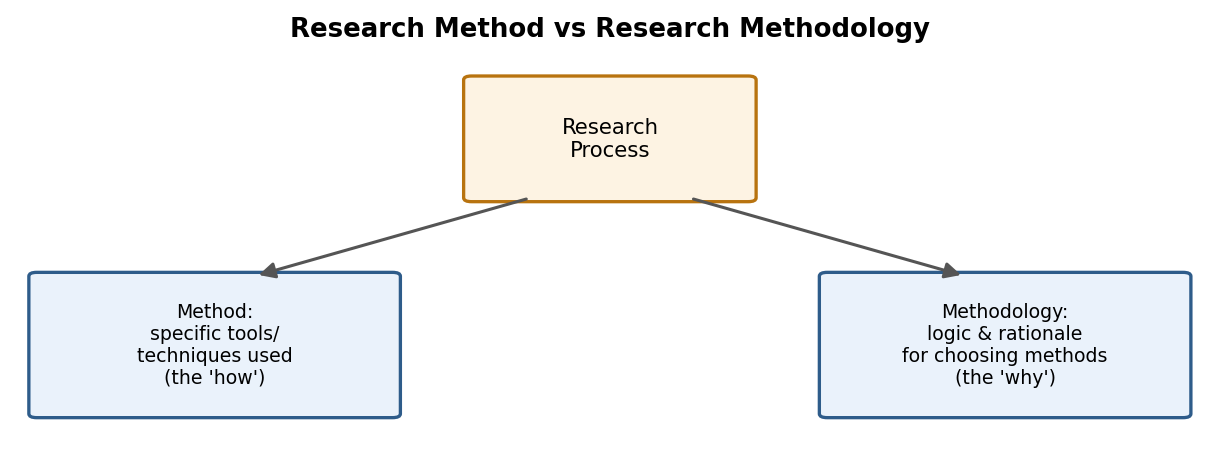
Q.1(e) Use of Law Library in Legal Research — 5 Marks
The law library is the primary workshop of doctrinal legal research, housing the essential raw material of law: statutes and bare acts, law reports and case digests, textbooks, commentaries, law journals, government and law commission reports, encyclopaedias, and legislative debates. It is used to locate the applicable statutory provision on a point, trace judicial precedents interpreting that provision, study academic commentary and criticism, and understand the historical evolution of a doctrine through successive editions of texts and reports. Effective use of the law library requires familiarity with indexing systems, digests, citators (to check whether a case is still good law), and increasingly, electronic legal databases such as SCC Online, Manupatra and AIR Online, which allow keyword and citation-based searches. Skilful use of the law library saves time, avoids reliance on outdated or overruled law, and ensures that legal research rests on authoritative and current sources.
Figure: Law Library
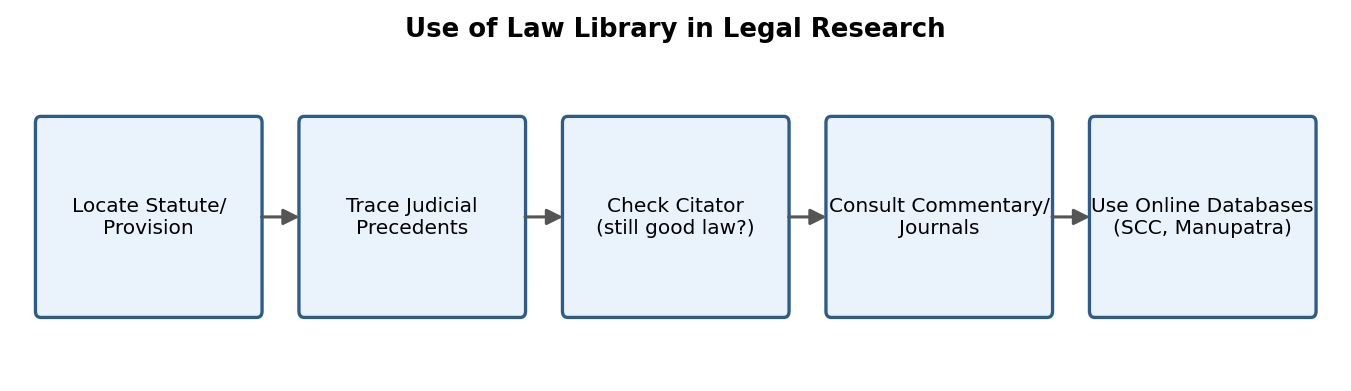
Q.1(f) Null Hypothesis and Alternative Hypothesis — 5 Marks
The null hypothesis (denoted H0) is a statement asserting that there is no relationship, no difference, or no effect between the variables under study; it represents the position of 'status quo' that the researcher sets out to test and, ordinarily, seeks to reject on the strength of the evidence gathered. The alternative hypothesis (denoted H1 or Ha) is the logical opposite of the null hypothesis; it asserts that a relationship, difference or effect does exist. For example, in a study on delay in courts, the null hypothesis might state 'there is no significant relationship between the number of adjournments and the pendency of cases,' while the alternative hypothesis would state that such a relationship does exist. Statistical testing is applied to the data to determine whether there is sufficient evidence to reject the null hypothesis in favour of the alternative; the null hypothesis is never proved 'true,' only either rejected or not rejected.
Figure: Null Alt Hypothesis
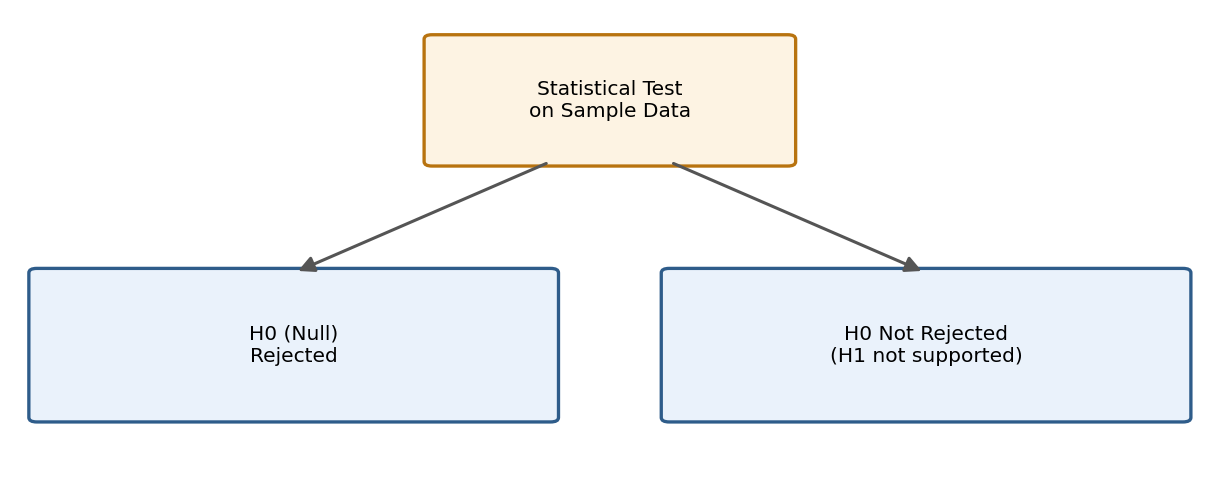
Q.1(g) Case Study Method — 5 Marks
The case study method involves an intensive, holistic and in-depth investigation of a single unit of study—an individual, family, institution, community, or a particular legal episode—undertaken to understand it comprehensively within its natural social context. The researcher gathers detailed information about the background, present status, and interrelation of various factors affecting the unit, often combining interviews, observation and documentary analysis. In legal research, case studies are frequently used, for instance, to examine how a particular statute has actually been implemented in a specific locality, or the socio-legal history of a landmark litigation. While the method yields rich, contextual and nuanced insight, its major limitation is that findings drawn from a single unit cannot be safely generalised to the wider population without further verification.
Figure: Case Study
Q.1(h) Action Research — 5 Marks
Action research is a participatory, problem-solving method of inquiry in which the researcher, often working together with the persons or community affected by a problem, studies a specific practical issue with the direct objective of bringing about improvement or change, rather than merely generating abstract knowledge. It typically follows a cyclical process of planning, action, observation and reflection, which may be repeated in successive cycles until the practical problem is satisfactorily addressed. In the legal and social context, action research might involve, for example, legal aid volunteers working with an underprivileged community to identify barriers to accessing justice and simultaneously implementing and evaluating remedial measures such as legal literacy camps. Its chief strength lies in its immediate practical utility and the active involvement of stakeholders, though it may lack the objectivity and generalisability of more detached forms of research.
Figure: Action Research
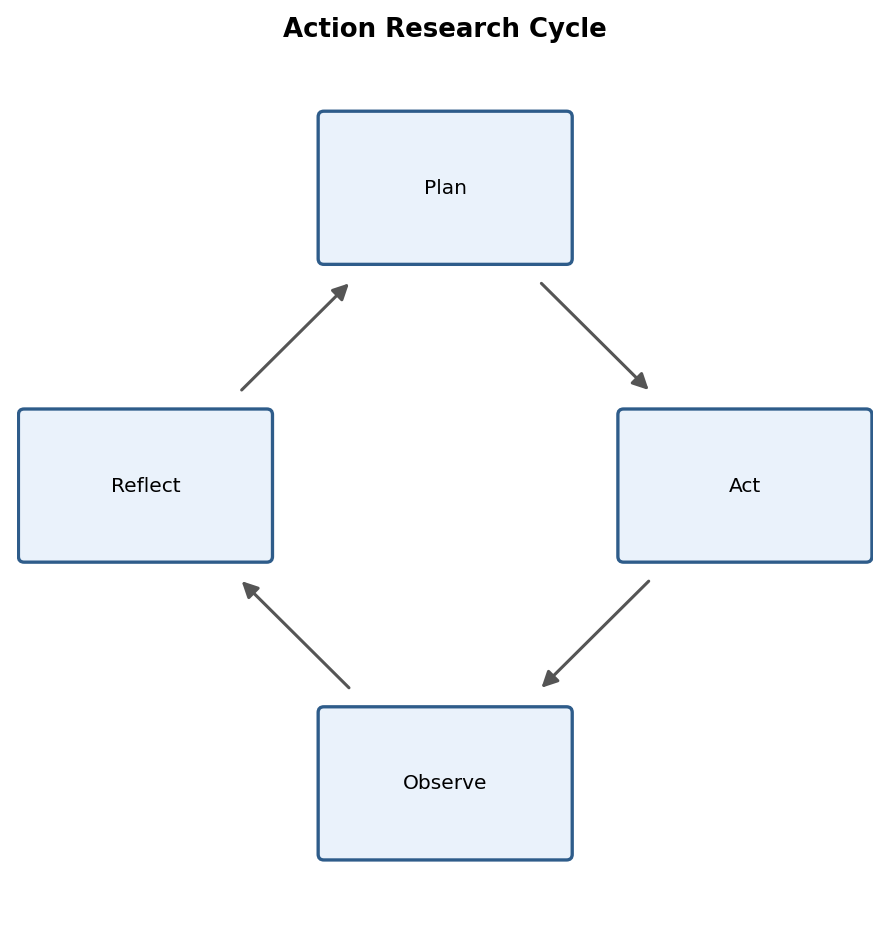
Q.1(i) Characteristics of a Good Research Report — 5 Marks
A good research report should possess several essential characteristics: clarity and simplicity of language, so that the findings are comprehensible even to non-specialist readers; logical organisation, presenting the problem, methodology, findings and conclusions in a coherent sequence; accuracy and objectivity, ensuring that facts are correctly stated and personal bias is avoided; conciseness, avoiding unnecessary repetition or padding while still being complete; and precision in the use of technical and legal terminology. It should be adequately supported by evidence, data, tables and citations, and should clearly distinguish between the researcher's findings and their interpretation or recommendations. It should also be original, honest in acknowledging limitations of the study, and properly documented with a bibliography or list of references to allow verification. Finally, a good report should be practically useful, offering findings or suggestions that are relevant to the problem it set out to investigate.
Figure: Report Structure
Q.1(j) Use of Computers as a Tool in Research — 5 Marks
Computers have transformed modern legal research by providing tools for the efficient storage, retrieval, analysis and presentation of data. Legal databases such as SCC Online, Manupatra, AIR Online, Westlaw and India Code enable researchers to search vast repositories of statutes and case-law by keyword, citation, or subject within seconds, a task that would take days using physical law reports. Statistical software such as SPSS and Excel assist in coding, tabulating and analysing empirical data collected through questionnaires or schedules, generating charts, cross-tabulations and significance tests. Word-processing and reference-management software (such as Zotero or EndNote) aid in drafting, formatting and automatically generating citations and bibliographies in the required style. The internet further provides access to global academic journals, government reports, and comparative legislation. For example, a researcher studying the trend of bail orders in a High Court can use a database to collect hundreds of judgments and use spreadsheet software to statistically analyse the grant/rejection rate, something practically impossible through manual methods alone.
Figure: Computers Tool
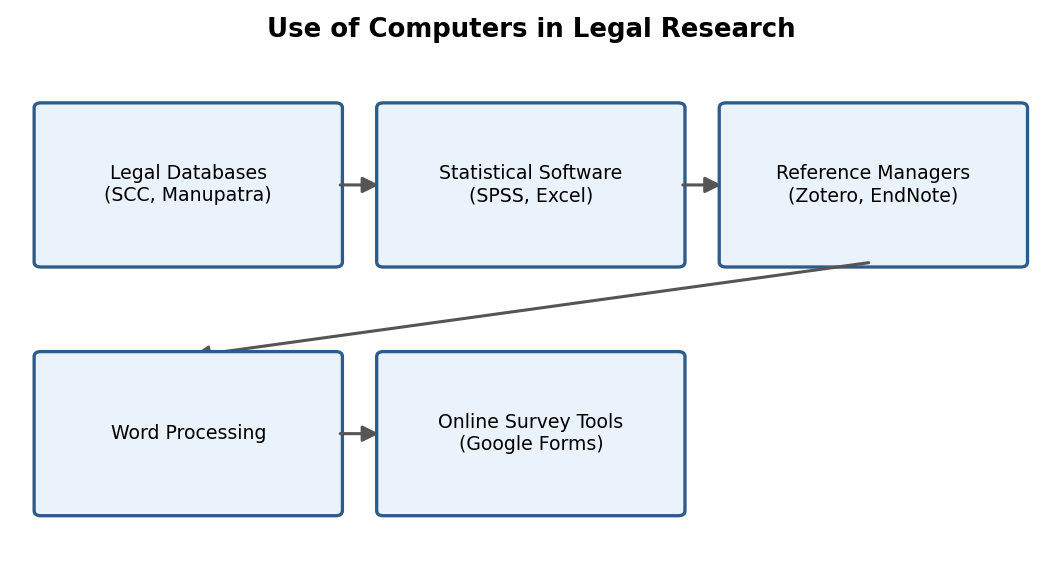
Q.2 Meaning and Significance of Research Design — 4+6 = 10 Marks
Meaning: A research design is the overall plan, structure and strategy of investigation conceived so as to obtain answers to research questions and to control variance; it specifies in advance the methods and procedures for collecting and analysing the required data, essentially serving as the blueprint for the entire research project. It typically addresses questions such as what the study is about, why it is being undertaken, what type of data is needed, where and from whom the data will be collected, what techniques of data collection and analysis will be used, and within what time frame the study will be completed.
Significance: Research design is significant because it provides the framework that ensures the research is conducted systematically, efficiently and with minimum ambiguity, error or waste of resources. It helps in obtaining maximum relevant information with minimum expenditure of time, money and effort; it facilitates the smooth flow of the various research operations, thereby making the study efficient; it minimises bias and maximises reliability of the data collected; it provides for appropriate methods of data collection and analysis suited to the research problem; and it enables the researcher to anticipate practical difficulties in advance and plan accordingly. Without a sound research design, a study risks producing unreliable, unfocused, or unusable findings.
In practical terms, a research design for a study on, say, the functioning of Lok Adalats would specify: the objective (to assess settlement rates and litigant satisfaction); the type of design (a descriptive, cross-sectional, mixed-method design combining doctrinal analysis of the Legal Services Authorities Act with an empirical survey); the universe and sample (a defined number of Lok Adalats and litigants within a stated period and region, selected through an appropriate sampling technique); the tools of data collection (a structured questionnaire for litigants and an interview schedule for presiding officers); and the plan of analysis (simple percentage analysis of settlement rates, supplemented by qualitative thematic analysis of litigant responses). Fixing all of this in advance prevents the common pitfalls of ad hoc research, such as discovering midway through data collection that a crucial variable was never measured, or that the sample size is too small to support any statistically meaningful conclusion.
Figure: Research Design
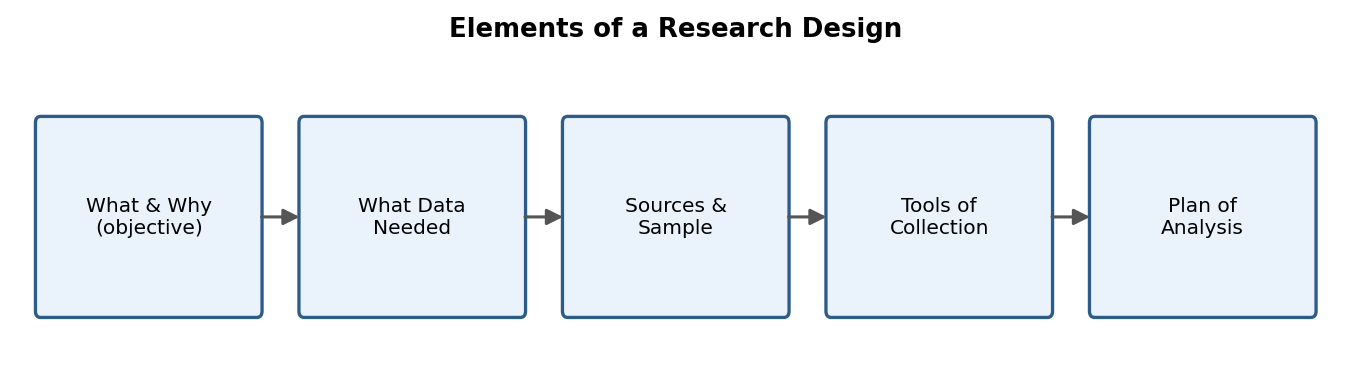
Q.3 What is Data? Sources of Data Collection — 10 Marks
Data refers to the facts, figures, statistics, or information gathered by a researcher, which upon systematic classification, analysis and interpretation, provide the empirical basis for testing a hypothesis or answering a research question. Data can be qualitative, describing attributes, characteristics or opinions in non-numerical form, or quantitative, expressed in numerical or statistical terms.
Data is collected from two broad sources. Primary sources yield original, first-hand data that the researcher personally gathers for the specific purpose of the study at hand, for instance through questionnaires distributed to litigants, interviews with judges or lawyers, direct courtroom observation, or personally examined case files; this data has not been filtered or interpreted by any intermediary. Secondary sources consist of data already collected, compiled and published by others for some other purpose, which the researcher then reuses, such as census reports, National Crime Records Bureau statistics, Law Commission of India reports, government publications, previously published surveys, textbooks, journal articles and newspaper archives. Legal researchers generally rely on secondary sources for background, context and comparison, while collecting primary data to answer the specific questions unique to their own study. The choice between primary and secondary sources depends on the availability, reliability, cost, and time constraints of the research.
A further distinction is often drawn between quantitative data, expressed numerically and amenable to statistical operations such as averages, percentages and correlations (for instance, the number of cases disposed of by a court in a year), and qualitative data, which captures non-numerical attributes such as attitudes, motivations or perceived fairness (for instance, a litigant's account of why they distrust the legal process). Good legal research frequently combines both: a study on undertrial detention might use quantitative prison statistics obtained from the National Crime Records Bureau (a secondary source) alongside qualitative interviews with undertrials themselves (a primary source), so that the numerical scale of the problem is placed alongside a first-hand account of its human dimension. Whichever the source, data must be checked for reliability (would the same method yield consistent results if repeated) and validity (does the data actually measure what it purports to measure), since flawed data inevitably produces flawed conclusions.
Figure: Data
Figure: Sources Tools Data Collection
Q.4 Techniques of Writing Report — 4+6 = 10 Marks
Writing a research report is the final and crucial stage of the research process, requiring the researcher to present the problem, methodology, findings and conclusions in a systematic, logical and readable form. The essential techniques include: first, outlining the structure in advance, typically comprising a title page, acknowledgement, table of contents, introduction (stating the problem, objectives, and hypothesis), review of literature, research methodology, presentation and analysis of data (often supported by tables, charts and diagrams), findings and discussion, conclusions and recommendations, and a bibliography with appendices.
Other important techniques of good report writing include: using simple, precise and unambiguous language, avoiding excessive jargon; maintaining objectivity and avoiding personal bias in stating findings; supporting statements with adequate evidence and proper citation of sources; using consistent formatting, headings and numbering for easy navigation; presenting quantitative data through appropriate tables, graphs or statistical summaries rather than dense prose; proof-reading carefully for accuracy, grammar and consistency of citation style; and, importantly, distinguishing clearly between the researcher's factual findings and their own interpretation, opinion or recommendations. A well-written report should be complete yet concise, and should be revised multiple times before finalisation to ensure clarity and correctness.
Beyond structure and language, effective legal report-writing also requires attention to the accurate and consistent citation of statutes and case-law throughout the text, since an unreferenced legal claim carries little authority; the use of footnotes or endnotes for elaboration without cluttering the main text; the careful labelling and cross-referencing of tables, charts and appendices so that a reader can move seamlessly between the narrative and the supporting data; and a clear separation between the descriptive part of the report (what was found) and the normative part (what the researcher recommends), so that readers can distinguish the researcher's factual findings from their personal or policy opinions. Reports intended for policy-makers, such as those prepared for Law Commissions or legislative committees, additionally benefit from an executive summary at the outset, condensing the key findings and recommendations into a page or two for readers who may not have time to study the full report.
Figure: Report Structure
Q.5 Data Collection Through Questionnaire; Questionnaire vs Schedule — 10 Marks
Data Collection Through Questionnaire: A questionnaire is a self-administered structured research instrument consisting of a list of written questions, along with the format for answers, which is given directly to respondents—by post, in person, or electronically—for them to read, understand and answer on their own, without the researcher being present. The questions may be open-ended, allowing free-form answers, or closed-ended, offering predetermined choices, and must be arranged logically, using clear and unambiguous language, and pre-tested (piloted) before large-scale administration to identify and remove flaws. This method is economical, can be administered to a large and widely dispersed sample simultaneously, ensures a degree of respondent anonymity that may encourage more candid answers, and generates data that is relatively easy to tabulate.
Difference between Questionnaire and Schedule: The fundamental difference lies in who fills in the responses. In a questionnaire, the respondent reads the questions and records his or her own answers, without the researcher being physically present; whereas in a schedule, an enumerator or investigator visits the respondent, personally asks the questions, and fills in the answers on the respondent's behalf. Consequently, the questionnaire method is comparatively cheaper and covers a wider geographical area, but suffers from a lower response rate and the risk of misunderstood questions since no one is present to clarify doubts. The schedule method, being administered by a trained investigator, ensures a higher response rate, allows clarification of doubtful questions, and can be used even with illiterate respondents, but it is more expensive, time-consuming, and carries a greater risk of interviewer bias influencing the respondent's answers.
For example, a study intended to gauge awareness of consumer protection rights among urban, literate shoppers could efficiently use a mailed or online questionnaire, since the target group can read and answer independently, and a large sample can be reached cheaply. The same study, if extended to assess awareness among rural or semi-literate agricultural labourers regarding their rights under a minimum-wages statute, would necessarily require a schedule, with trained investigators visiting respondents, reading out the questions, and recording answers accurately, since a self-administered questionnaire would be unusable by a population that cannot read it. The choice between the two instruments is therefore not merely one of cost but is dictated by the literacy, accessibility and reliability requirements of the specific population being studied.
Figure: Questionnaire Vs Schedule
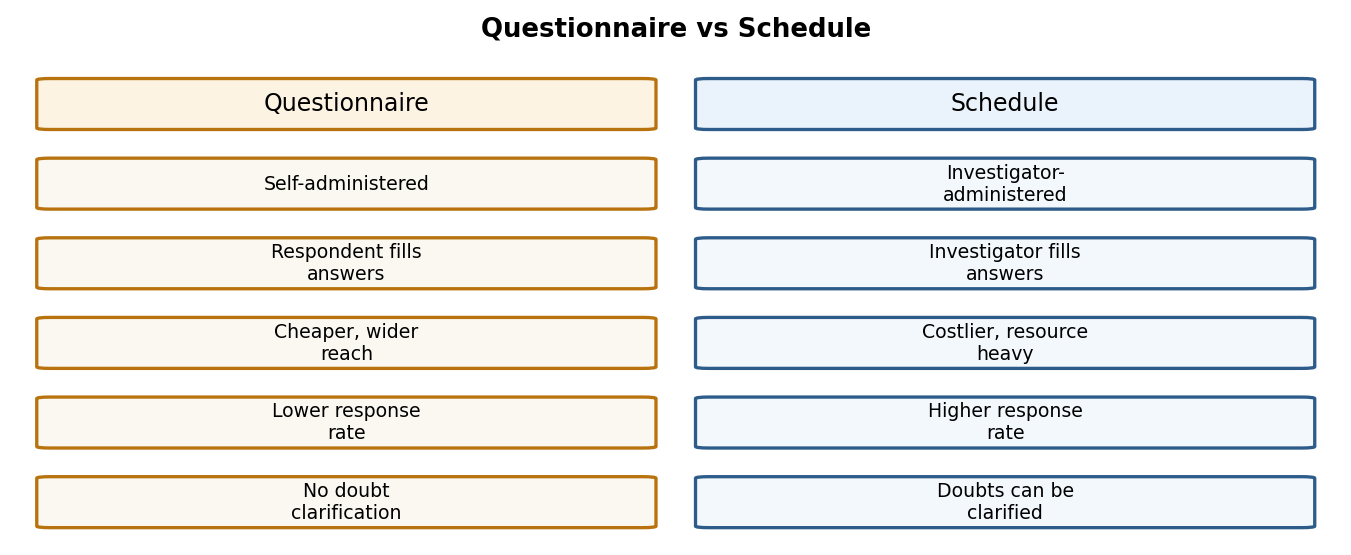
Q.6 Case Study Method vs Survey Method; Merits and Limitations of Case Study — 10+10 = 20 Marks
Case Study Method vs Survey Method: The case study method involves an intensive, in-depth study of a single unit—an individual, institution or community—examined comprehensively in its natural setting, whereas the survey method involves the collection of relatively limited information from a large number of units (a sample drawn from a population) using standardised tools such as questionnaires or schedules, in order to generalise findings across the population. The case study is qualitative and intensive, using multiple techniques (interview, observation, document analysis) on one unit over an extended time, while the survey is typically extensive and often quantitative, spreading a fixed set of questions thinly across many respondents. The case study offers depth and rich contextual understanding but weak generalisability, whereas the survey offers breadth and statistical generalisability but comparatively shallow understanding of any single unit. In legal research, a case study might examine how one particular village accessed a legal aid scheme in detail, whereas a survey would collect brief standardised responses from litigants across an entire district to measure general awareness of the scheme.
Merits and Limitations of Case Study Method: The merits of the case study method include: it provides a comprehensive, holistic understanding of the unit under study, capturing complexity and nuance that broader surveys miss; it is particularly useful for studying rare, unique, or complex phenomena where a large sample is unavailable or unnecessary; it can generate rich hypotheses for further, larger-scale empirical testing; and it allows flexibility in the use of multiple data-collection techniques. Its limitations include: findings from a single or a few units cannot be safely generalised to the wider population, raising concerns of external validity; the method is time-consuming and resource-intensive relative to the size of the sample studied; it is vulnerable to the subjective bias of the researcher in selecting, interpreting and reporting the case; and the lack of standardisation makes it difficult to replicate or statistically verify the findings. For these reasons, the case study method is best used as a complement to, rather than a substitute for, wider empirical or survey-based research.
The complementary relationship between the two methods can be illustrated through a two-stage research strategy: a researcher investigating the functioning of Fast Track Special Courts for sexual offence cases might begin with a survey across all such courts in a state, using a standardised schedule to collect quantitative data on case pendency, average trial duration, and conviction rates, thereby identifying the courts with the poorest and the best performance. Having identified an outlier — say, one court with an unusually high pendency rate — the researcher could then switch to the case study method, spending extended time at that specific court, interviewing the presiding judge, public prosecutor, and court staff, and examining individual case files, to understand the particular administrative, infrastructural or procedural reasons behind its poor performance. The survey thus supplies the breadth necessary to locate the problem and demonstrate its statistical significance, while the case study supplies the depth necessary to explain it; used sequentially in this manner, the two methods reinforce rather than substitute for one another, and this combined 'sequential explanatory' design is increasingly favoured in rigorous socio-legal research.
Figure: Case Study Vs Survey
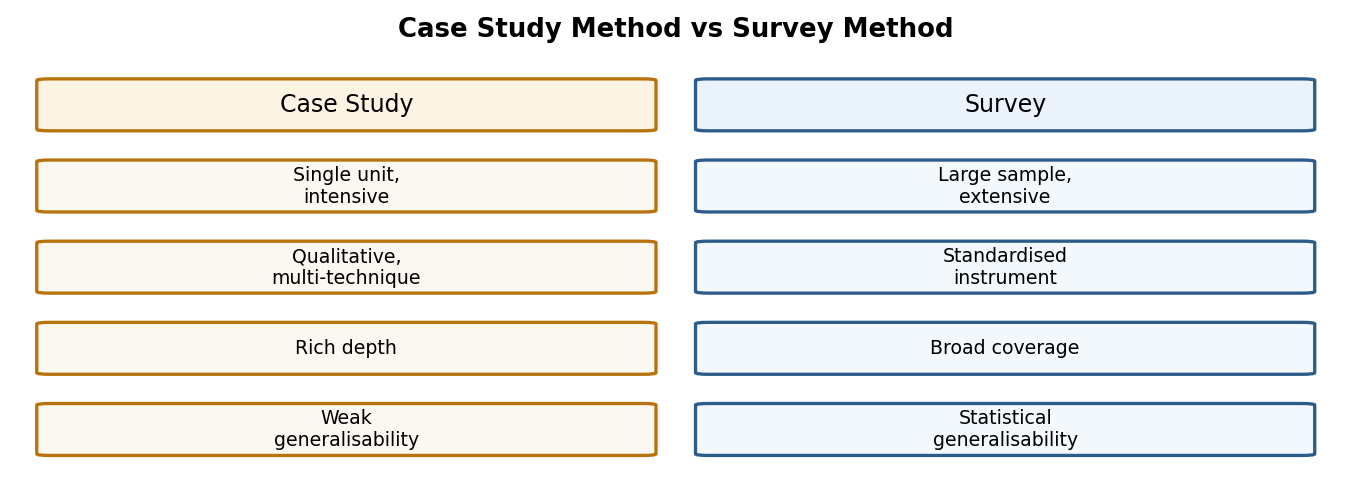
Q.7 Non-Doctrinal Research and Its Methods; Comparison with Doctrinal Research — 10+10 = 20 Marks
Non-Doctrinal Research and Its Methods: Non-doctrinal research, also called empirical or socio-legal research, studies law as a living social phenomenon rather than merely as a body of enacted rules, examining how legal norms actually function, their causes and consequences, and their interaction with social, economic and political realities. It aims to bridge the gap between the formal 'law in books' and the actual 'law in action.' Its principal methods include the survey method, for collecting standardised data from a sample of a population using questionnaires or schedules; the case study method, for an intensive study of a single unit; the interview method, structured or unstructured, for detailed qualitative data; the observation method, whereby the researcher directly watches legal institutions or processes in operation, such as court proceedings; and statistical and documentary/content-analysis methods, for the systematic study of quantitative data or official records. These methods allow the researcher to test, for instance, whether a labour welfare statute is actually reaching its intended beneficiaries, or how efficiently a particular court disposes of cases.
A worked example demonstrates these methods in combination: to test whether the Maternity Benefit Act is actually reaching women employed in the unorganised sector, a researcher could use the survey method to distribute a standardised questionnaire to a representative sample of women workers across several factories, generating quantitative data on the percentage who actually received the statutory benefit; the case study method to conduct an in-depth investigation of one particular factory where compliance appears unusually poor, in order to understand the specific institutional or social reasons behind the failure; the interview method to speak candidly and at length with labour inspectors about enforcement challenges they face; and the observation method to attend, as a non-participant, meetings of a labour welfare board to see first-hand how complaints are actually processed. Used together, these methods generate both the statistical breadth needed to describe the scale of non-compliance and the qualitative depth needed to explain why it occurs — a combination that neither a purely doctrinal reading of the Act nor any single empirical tool used alone could achieve.
Comparison Between Doctrinal and Non-Doctrinal Research: Doctrinal research is confined to the analytical study of statutes, judicial decisions and juristic commentary using logical reasoning, and is concerned with what the law formally is; non-doctrinal research uses empirical field methods to study what the law actually does in society. Doctrinal research is comparatively quicker, less expensive, and can be conducted from a law library, while non-doctrinal research is more time-consuming, resource-intensive, and requires field work, sampling and often statistical analysis. Doctrinal research produces a restatement, clarification, or critique of legal doctrine; non-doctrinal research produces findings about the practical operation, efficacy, and social impact of law, often accompanied by concrete policy recommendations. The two methods, however, are complementary rather than competing: a sound understanding of doctrinal law is usually the necessary starting point before its social operation can be meaningfully studied through non-doctrinal, empirical techniques. Indeed, most Law Commission of India reports illustrate this complementarity well, typically opening with a doctrinal survey of the existing statutory position and comparative law, before drawing on empirical inputs — public consultations, submissions, and sometimes commissioned surveys — to assess whether and how the existing law is failing in practice, and only then proceeding to recommend specific legislative amendments.
Figure: Nondoctrinal Methods
Figure: Doctrinal Vs Nondoctrinal
PAPER – 2025 (LL.B/S-2/LLB-206/25)
Q.1 Tools of Data Collection — 5 Marks
The main tools used for collecting primary data in research are: the questionnaire, a self-administered set of written questions filled in by the respondent without the researcher's presence; the schedule, a similar set of questions filled in by a trained investigator on behalf of the respondent, useful where respondents are illiterate; the interview, involving direct oral questioning, either structured (fixed questions) or unstructured (flexible, open-ended); observation, whereby the researcher directly watches and records behaviour or events, either as a participant or non-participant; and the case study, an intensive study of a single unit using multiple techniques together. The selection of an appropriate tool depends on the nature of the research problem, the characteristics and literacy level of respondents, the resources and time available, and whether qualitative or quantitative data is required.
Figure: Sources Tools Data Collection
Q.2 Concept of Legal Research — 5 Marks
Legal research is the disciplined, systematic process of identifying, locating, analysing and evaluating legal materials such as statutes, judicial precedents and juristic writings, in order to ascertain the existing state of law, test its validity, clarify ambiguity, or examine its social operation and consequences. It may be doctrinal, confining itself to legal texts, or non-doctrinal, examining law's actual functioning through empirical tools. Legal research is essential to legal practice, adjudication, legislation and academic scholarship, since it provides the factual and analytical foundation for legal argument, judicial reasoning, and law reform, ensuring that decisions and rules rest on an accurate and current understanding of the law.
Figure: Steps Legal Research
Q.3 Define Hypothesis — 5 Marks
A hypothesis is a tentative, provisional statement or supposition about the relationship between two or more variables, formulated by the researcher before data collection begins, which is subsequently tested, and either confirmed or rejected, on the basis of empirical evidence. It gives direction and focus to research by specifying precisely what the researcher expects to find. A hypothesis must be clear, specific, testable and consistent with known facts. It is usually stated in two complementary forms: the null hypothesis, asserting no relationship or difference exists, and the alternative hypothesis, asserting that such a relationship or difference does exist; statistical testing is applied to the collected data to determine which of the two the evidence supports.
Figure: Hypothesis
Q.4 Why is Sampling Used in Research Studies? — 5 Marks
Sampling is the process of selecting a representative subset (sample) of units from a larger population, so that conclusions drawn from studying the sample can validly be generalised to the entire population. Sampling is used in research for several reasons: it is often physically and financially impossible to study an entire population, especially where it is very large or widely dispersed; sampling saves time, money and manpower compared to a complete census; a well-designed sample can, in fact, yield more accurate results than a hurried census because greater care and supervision can be devoted to a smaller number of units; sampling also allows the intensive study of the characteristics selected, and it makes research feasible even when the population is infinite, unknown, or difficult to enumerate exhaustively, such as all persons who have ever accessed a particular legal remedy.
Figure: Sample Design
Q.5 Case Study Method — 5 Marks
The case study method is a method of intensive, in-depth investigation of a single unit of study, such as an individual, family, institution, organisation, or community, aimed at gaining a comprehensive and contextual understanding of that unit, including its history, present condition, and the relationship between the various factors affecting it. It typically combines several data-collection techniques—interviews, observation, and analysis of documents or records—to build a rich, holistic picture. In legal research, it is frequently used to study, for example, the socio-legal history of a landmark case or the on-ground implementation of a statute in a particular community. Its principal limitation is that, being confined to a single unit, its findings cannot readily be generalised to a wider population.
Figure: Case Study
Q.6 Compare Between Doctrinal and Non-Doctrinal Research — 5 Marks
Doctrinal research is confined to the systematic analysis of legal texts—statutes, case-law and juristic commentary—using logical and analytical reasoning to state and clarify 'the law as it is'; it is quicker, library-based and less expensive. Non-doctrinal (empirical) research, by contrast, studies the actual social operation and impact of law using field-based tools such as surveys, interviews, and observation, focusing on 'law in action'; it is more time-consuming, resource-intensive, and requires sampling and often statistical analysis. Doctrinal research produces a restatement or critique of legal doctrine, while non-doctrinal research produces empirical findings about law's practical effect, often with policy recommendations. The two are complementary, since sound empirical research must rest upon an accurate doctrinal understanding of the applicable law.
Figure: Doctrinal Vs Nondoctrinal
Q.7 Distinguish Between Research Method and Research Methodology — 5 Marks
Research method refers to the specific tools and techniques employed to collect and analyse data, such as the interview method, questionnaire method, observation method or statistical method — essentially the practical 'how' of data collection and analysis. Research methodology is the broader, systematic study and justification of the methods used, encompassing the underlying logic, philosophy and rationale of the entire research process, including problem formulation, choice of design, and the reasons for selecting particular methods over others. In short, methods are specific techniques or tools, while methodology is the overarching science and reasoning that governs the selection and application of those tools; method is a component within the wider framework of methodology.
Figure: Method Vs Methodology
Q.8 How is Law Library Used in Legal Research? — 5 Marks
The law library is the essential workshop for doctrinal legal research, providing access to bare acts and statutes, official law reports and case digests, textbooks and commentaries, law journals, government and Law Commission reports, legislative debates, and legal encyclopaedias. A researcher uses the library to locate applicable statutory provisions, trace the line of judicial precedents interpreting them, verify whether a decision is still good law using citators, and consult academic commentary for critical analysis. Increasingly, the physical law library is supplemented, and in many respects replaced, by online legal databases such as SCC Online, Manupatra and AIR Online, which allow rapid keyword and citation-based searches, though the underlying research skills of identifying, verifying and analysing authoritative sources remain the same.
Figure: Law Library
Q.9 What is Data? — 5 Marks
Data refers to the facts, figures, or information collected during the course of a research study, which, upon systematic classification, analysis and interpretation, provide the evidentiary basis for testing hypotheses and drawing conclusions. Data may be primary, collected first-hand by the researcher specifically for the study through questionnaires, interviews or observation, or secondary, already collected by others and available in published reports, statistics or literature. Data may also be qualitative, describing non-numerical characteristics such as opinions or experiences, or quantitative, expressed in numerical form and amenable to statistical analysis. The reliability, accuracy and relevance of the data collected directly determine the validity of the research findings.
Figure: Data
Q.10 Define Hypothesis — 5 Marks
As noted above (Q.3), a hypothesis is a tentative, testable proposition or educated guess about the relationship between variables, formulated in advance of data collection to guide the research and later verified, modified, or rejected on the basis of the evidence gathered. It must be specific, clear, and empirically testable, and is generally expressed in the paired form of a null hypothesis, denying any relationship, and an alternative hypothesis, asserting that a relationship exists, between which statistical analysis of the collected data helps the researcher decide.
Figure: Null Alt Hypothesis
Q.11 Non-Doctrinal Research and Its Methods — 10 Marks
Non-doctrinal research, also termed empirical or socio-legal research, studies law not merely as an abstract set of textual rules but as a functioning social institution, examining its actual operation, causes, effects, and interaction with society, in order to bridge the gap between the 'law in books' and 'law in action.' The principal methods employed are the survey method, collecting standardised data from a sample using questionnaires or schedules; the case study method, an intensive study of a single unit; the interview method, structured or unstructured oral questioning; the observation method, direct watching and recording of behaviour, for example in a courtroom setting; and statistical or documentary/content-analysis methods, for systematically examining quantitative data or official records such as court files. These tools together enable a researcher to empirically test how effectively a legal provision is implemented, how it is perceived by those it affects, and what practical barriers exist to its enforcement, thereby generating evidence-based recommendations for reform.
A concrete illustration helps: to evaluate whether the Juvenile Justice Act is achieving its rehabilitative purpose, a researcher could combine the survey method (questionnaires administered to a sample of Juvenile Justice Board members across several districts to gauge their perception of institutional facilities), the case study method (an in-depth study of one Observation Home to understand its day-to-day functioning), the interview method (unstructured conversations with social workers and, where ethically permissible, with juveniles themselves), and the observation method (attending Board proceedings as a non-participant observer). The findings from each method would then be triangulated — that is, cross-checked against one another — to build a more reliable and comprehensive picture than any single method could provide on its own, since the weaknesses of one tool (for instance, the limited generalisability of a case study) are offset by the strengths of another (the broader coverage of a survey).
Figure: Nondoctrinal Methods
Q.12 Use of Computers as Tools in Research — 10 Marks
Computers have become indispensable to modern legal research. Online legal databases such as SCC Online, Manupatra, AIR Online and India Code allow researchers to search vast bodies of statutes and case-law instantly by keyword, subject or citation, replacing what once took days of manual searching through physical law reports. Statistical software such as SPSS, R or Microsoft Excel enable coding, tabulation, cross-tabulation and significance testing of empirical data obtained through questionnaires or schedules, and can generate charts and graphs for clear presentation of findings. Reference-management tools such as Zotero or EndNote assist in automatically generating and formatting citations and bibliographies according to a chosen style, reducing manual error. Word-processing software aids in drafting, editing and formatting the final research report. For example, a study on sentencing patterns across a set of criminal judgments can use a database to compile hundreds of judgments and spreadsheet software to statistically analyse variables such as offence type, sentence length and bail outcome, generating insights that would be virtually impossible to derive manually within a reasonable time.
Computers also assist in the design and administration of the research instrument itself: online survey tools such as Google Forms allow a questionnaire to be distributed to, and automatically collated from, hundreds of respondents across a wide geographic area at negligible cost, while built-in validation features reduce the incidence of incomplete or inconsistent responses that plague paper-based questionnaires. Cloud storage and version-control tools further allow multiple researchers on a collaborative project to work on the same dataset or draft report simultaneously. At the same time, the use of computers raises its own methodological cautions: over-reliance on keyword search in legal databases can cause a researcher to miss relevant material indexed under different terminology, and statistical software will readily generate a numerically 'significant' result even from poorly designed data, so the researcher's own judgment in framing the research question, selecting the sample, and interpreting the output responsibly remains indispensable notwithstanding the power of the technology used.
Figure: Computers Tool
Q.13 Different Types of Research; Characteristics of a Good Research Report — 10 Marks
Different Types of Research: Research may be classified on the basis of purpose into descriptive research, which describes the existing state of a phenomenon; analytical research, which critically evaluates already available information; and exploratory research, which investigates a relatively unstudied problem to generate hypotheses. On the basis of approach, research is classified into quantitative research, dealing with numerical data subjected to statistical analysis, and qualitative research, dealing with non-numerical descriptions of experiences, attitudes and meanings. On the basis of application, research may be fundamental (pure), aimed at generating knowledge for its own sake, or applied, aimed at solving a specific practical problem. In the specific context of law, the most significant classification is between doctrinal research, confined to legal texts and precedents, and non-doctrinal/empirical research, which studies law's social operation through field-based tools; other recognised types include historical research, tracing the evolution of a legal institution, and comparative research, examining law across jurisdictions.
Characteristics of a Good Research Report: A good research report is characterised by clarity and simplicity of language; logical and systematic organisation of content, from problem statement through methodology to findings and conclusions; accuracy and objectivity in the presentation of facts, free from personal bias; conciseness, avoiding unnecessary repetition while remaining complete; adequate support of statements by evidence, data and proper citation; and honesty in acknowledging the limitations of the study. It should be original, properly documented with a bibliography for verification, and should ultimately be practically useful, offering findings and recommendations relevant to the problem investigated.
It is useful to illustrate the classification of research with concrete legal examples: a study cataloguing the different grounds of judicial review recognised under Indian administrative law would be descriptive; a study critically evaluating whether the 'basic structure' doctrine has been consistently applied by the Supreme Court would be analytical; a study exploring the relatively new and under-researched question of how artificial intelligence tools are being used in Indian courtrooms would be exploratory; a study measuring whether a change in bail law actually reduced undertrial populations would be applied and quantitative; while a study of how litigants subjectively experience court delay would be qualitative. Recognising which type of research a given problem calls for is itself an important analytical skill, since selecting an inappropriate type — for instance, attempting a purely quantitative study of a question that is fundamentally about lived experience and meaning — will produce a report that is methodologically unsound however carefully it is written.
Figure: Methods Classification
Figure: Report Structure
Q.14 Objectives of Legal Research; Meaning and Significance of Research Design — 10 Marks
Objectives of Legal Research: The principal objectives of legal research are: to ascertain and clarify the existing state of law on a given subject; to test the validity, consistency, and adequacy of existing legal rules and principles; to trace the historical evolution of legal doctrines; to study the practical, social operation and impact of law, identifying the gap, if any, between the law as enacted and the law as applied; to compare legal rules across different jurisdictions to draw lessons for domestic reform; and, ultimately, to generate recommendations for legislative amendment, judicial development, or policy change so that the law remains responsive to evolving social needs.
Meaning and Significance of Research Design: A research design is the overall plan or blueprint of a study, laid down in advance, specifying what data is to be collected, from what sources, by what methods, and how it will be analysed, so as to answer the research questions with minimum ambiguity and bias. Its significance lies in ensuring that the study proceeds systematically and efficiently, obtaining maximum relevant information with minimum expenditure of time, money and effort; minimising errors and bias; ensuring that the methods of data collection and analysis are appropriate to the research problem; and enabling the researcher to foresee and plan for practical difficulties. A sound research design is thus the foundation upon which the reliability and validity of the entire research project rests.
Taking a concrete example, a researcher pursuing the objective of studying the practical impact of the POCSO Act on child sexual abuse trials would need a research design specifying: the precise objective (to assess conviction rates and trial duration under the special courts constituted under the Act); the doctrinal component (analysis of the statutory scheme and relevant Supreme Court guidelines); the empirical component (analysis of a defined sample of case records from designated special courts over a specified period, supplemented by interviews with special public prosecutors); the method of sampling (for instance, all cases disposed of in a chosen district over two years, rather than a small, unrepresentative handful); and the mode of analysis (statistical computation of conviction rates and average trial duration, compared against the statutory timeline). Without such a design fixed in advance, the researcher risks collecting data that cannot actually answer the objectives originally set, or discovering, only after considerable time has been invested, that the sample chosen is too small or unrepresentative to support any reliable conclusion.
Figure: Objectives Legal Research
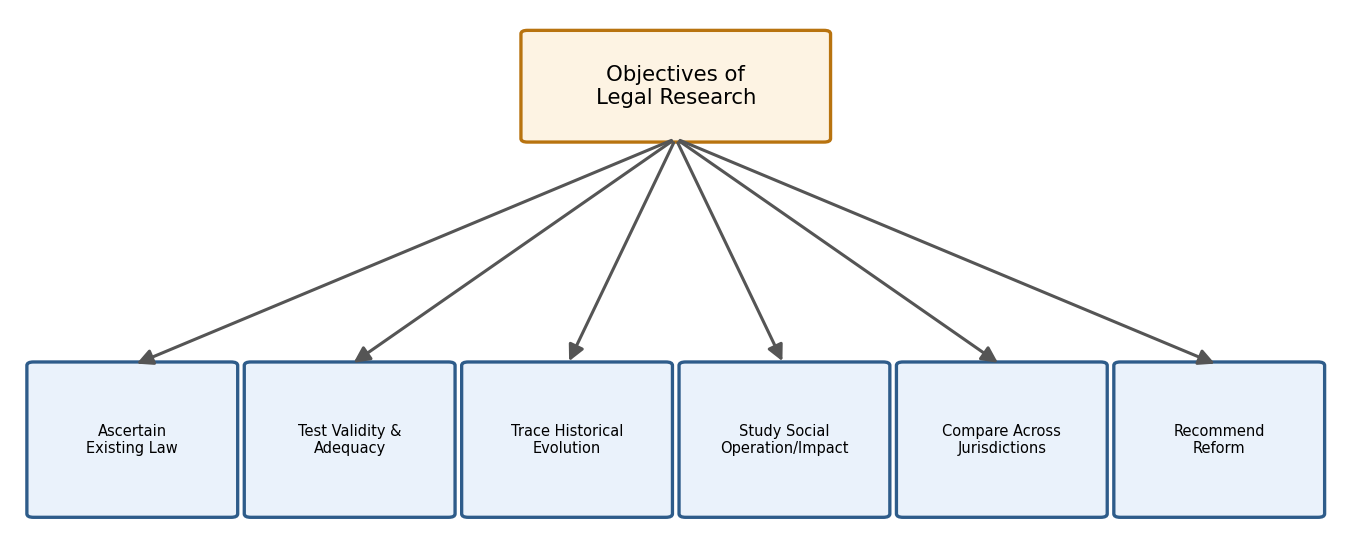
Figure: Research Design
Q.15 Procedure for Testing Hypothesis; Null and Alternative Hypothesis — 20 Marks
Procedure for Testing Hypothesis: Hypothesis testing is the statistical procedure by which a researcher determines, on the basis of sample data, whether there is sufficient evidence to reject a null hypothesis in favour of an alternative hypothesis. The procedure generally follows these steps: (i) formulating the null hypothesis (H0) and the alternative hypothesis (H1) clearly and precisely, based on the research problem; (ii) selecting an appropriate level of significance (commonly 5% or 1%), which represents the acceptable probability of wrongly rejecting a true null hypothesis; (iii) choosing an appropriate statistical test suited to the type and distribution of the data (for example, the t-test, chi-square test, or ANOVA); (iv) computing the test statistic from the sample data; (v) comparing the computed test statistic with the critical value from statistical tables, or comparing the resulting p-value with the chosen significance level; and (vi) drawing a conclusion — if the computed value falls in the rejection region (or the p-value is below the significance level), the null hypothesis is rejected in favour of the alternative hypothesis; otherwise, the null hypothesis is not rejected. Finally, the researcher interprets the statistical result in the substantive context of the research problem and states the practical implications of the finding.
Null Hypothesis and Alternative Hypothesis: The null hypothesis (H0) is the default or status-quo statement asserting that there is no relationship, difference, or effect between the variables being studied, and is the hypothesis the researcher formally sets out to test. The alternative hypothesis (H1), the logical negation of the null hypothesis, asserts that a relationship, difference, or effect does in fact exist. For instance, in a legal study examining whether legal aid awareness campaigns increase the rate of legal aid applications, the null hypothesis would state that the campaign has no effect on application rates, while the alternative hypothesis would state that it does have an effect. Statistical testing never 'proves' the null hypothesis true; it can only be rejected, in favour of the alternative, or not rejected, on the strength of the available evidence, leaving open the possibility of Type I error (wrongly rejecting a true null hypothesis) and Type II error (wrongly failing to reject a false null hypothesis).
A worked example clarifies the entire procedure: suppose a researcher hypothesises that legal literacy camps increase the rate at which villagers file consumer complaints. The null hypothesis (H0) would state that there is no difference in complaint-filing rates between villages that received legal literacy camps and those that did not; the alternative hypothesis (H1) would state that villages receiving the camps show a significantly higher complaint-filing rate. The researcher collects data on complaint-filing rates from a sample of villages in each category, sets the significance level at 5%, and applies an appropriate statistical test (for instance, a t-test comparing the two group means, or a chi-square test if the data is categorical). If the resulting p-value is below 0.05, the null hypothesis is rejected, supporting the conclusion that legal literacy camps do have a measurable effect; if the p-value is 0.05 or above, the null hypothesis is not rejected, meaning the data does not provide sufficient evidence of an effect, though this does not conclusively prove that no effect exists — it may simply mean the sample was too small, or the effect too weak, to be statistically detected. This last point is important in legal policy research, since a 'non-significant' result is often mistakenly reported as proof that an intervention 'does not work,' when the more accurate statistical statement is only that the available evidence was insufficient to establish that it does.
Figure: Hypothesis Testing Procedure
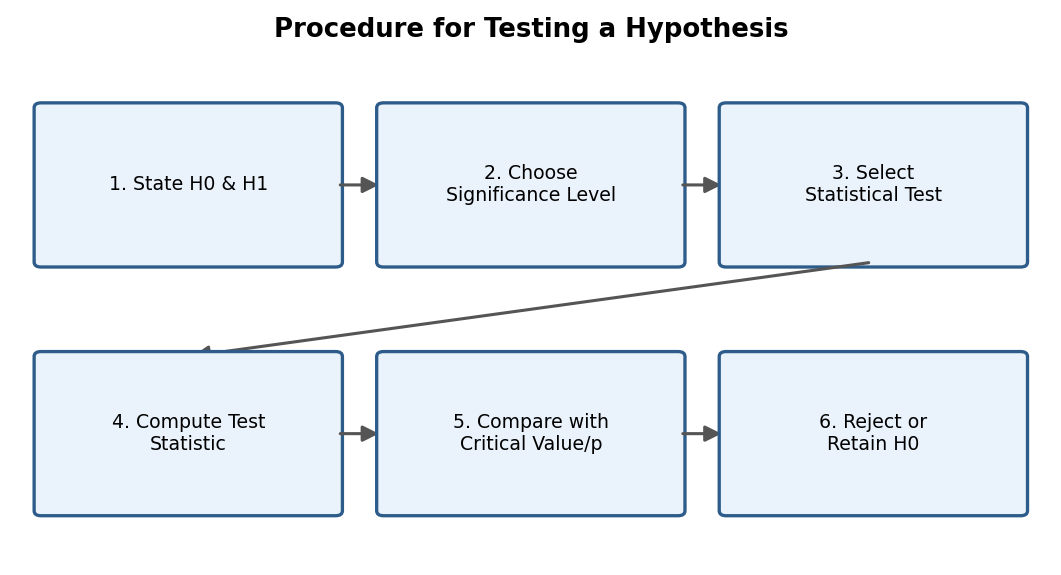
Figure: Null Alt Hypothesis
Q.16 Merits and Limitations of Case Study Method; Case Study vs Survey Method — 20 Marks
Merits and Limitations of Case Study Method: The case study method, involving an intensive and holistic study of a single unit, offers several merits: it provides deep, contextual and comprehensive understanding of a phenomenon that broader methods cannot capture; it is particularly suited to studying rare, unique, or complex situations where a large sample is unavailable; it allows flexible use of multiple techniques—interview, observation, documentary analysis—in combination; and it is valuable for generating rich hypotheses that can subsequently be tested on a larger scale through survey research. Its limitations, however, are equally significant: findings based on a single or a few units cannot be safely generalised to a wider population, limiting external validity; the method is time-consuming and resource-intensive relative to the small number of units studied; it is particularly susceptible to the researcher's own subjective bias in selecting the case, gathering information, and interpreting findings; and, since it lacks standardisation, its results are difficult to replicate or to verify statistically. It is, therefore, generally regarded as complementary to, rather than a substitute for, wider empirical research.
A useful qualification is that the limitations of the case study method are not fatal to its scientific value provided the researcher is candid about the scope of the claims being made. A case study does not claim statistical generalisability, but it can claim what researchers call 'analytical' or 'theoretical' generalisability — that is, the insights and mechanisms identified in one case may plausibly operate in other, similarly situated cases, even if the precise numbers cannot be extrapolated. For example, a detailed case study of how a single Gram Nyayalaya functions might reveal specific administrative bottlenecks — such as the absence of dedicated support staff — that are highly likely to affect other Gram Nyayalayas facing similar resource constraints, even though the study cannot state what percentage of all Gram Nyayalayas suffer the same problem without a follow-up survey.
Case Study Method vs Survey Method: The case study method intensively studies one unit in great depth and detail within its natural context, whereas the survey method collects relatively limited, standardised information from a large number of units (a representative sample) with the specific aim of generalising the findings to the entire population. The case study typically uses multiple qualitative techniques over an extended period on a single unit, while the survey typically uses a single standardised instrument, such as a questionnaire or schedule, applied uniformly and often more briefly across many respondents. Consequently, the case study offers depth, richness and contextual nuance but weak statistical generalisability, whereas the survey offers breadth and the capacity for statistical generalisation but comparatively limited depth of understanding of any single unit. In legal research, for example, a case study might closely examine how one particular slum community accessed a specific welfare scheme over several months, while a survey would gather brief, standardised responses on awareness of that scheme from a large, statistically representative sample drawn across an entire state.
In practice, the two methods are frequently combined in a single research project rather than treated as mutually exclusive alternatives: a preliminary survey can be used to map the general landscape of a legal problem and identify unusual or extreme cases worth deeper investigation, after which one or two of those cases are studied intensively to explain the mechanisms behind the patterns the survey revealed. This mixed design allows a researcher to combine the survey's strength in establishing 'what' is happening across a population with the case study's strength in explaining 'why' it is happening in specific instances, yielding a more complete and persuasive body of evidence than either method could produce in isolation.
Figure: Case Study
Figure: Case Study Vs Survey
Sample Questions:
Q1. Define research. What are the characteristics of research?
Research is a systematic, objective and logical process of enquiry undertaken to discover new facts, verify existing facts, or establish new relationships among facts, principles or theories. Etymologically the word is derived from the French "recherche", meaning "to go about seeking" — it combines "re" (again) and "search" (to examine closely), so research literally means to examine or investigate a subject thoroughly and repeatedly until reliable conclusions are reached.
Redman and Mory define research as "a systematized effort to gain new knowledge," while the Advanced Learner's Dictionary describes it as "a careful investigation or inquiry, especially through search for new facts in any branch of knowledge." Research is thus a scientific and systematic search for pertinent information on a specific topic, aimed at extending, correcting or verifying knowledge in any field.
Characteristics of research:
Systematic – it follows a definite, orderly set of steps from problem identification to conclusion; nothing is left to chance.
Objective and unbiased – conclusions are based on facts and verifiable evidence, free from the researcher's personal beliefs or prejudices.
Empirical – it is grounded in direct observation or experience and generates data that can be verified by observation or experiment.
Logical – the process is guided by the rules of logical reasoning, and induction and deduction are the "two legs" of scientific research.
Analytical – it uses proven analytical procedures (historical, descriptive, experimental or case-study methods) rather than mere guesswork.
Replicable/verifiable – the design and procedures should be capable of being repeated by other researchers to test the validity of the findings.
Critical – it involves careful, precise, and critical judgment in evaluating existing as well as newly collected data.
Purposive and problem-oriented – it starts from a felt problem or question and is directed towards a definite objective.
Ethical – it must respect the rights, dignity and confidentiality of participants and maintain honesty in reporting.
Together these characteristics distinguish genuine research from casual fact-finding, ensuring that its findings are reliable, valid and useful for both theory-building and practical problem-solving.
Q2. Explain the need for research in social science and business.
Research is indispensable in both the social sciences and the business world because it converts uncertainty into informed decision-making.
In the social sciences, research helps to understand human behaviour, social institutions, culture, law and governance. It enables scholars to test social theories against empirical reality, to diagnose social problems such as poverty, crime, gender inequality or discrimination, and to design and evaluate policies (welfare schemes, legal reforms, educational programmes) meant to address them. Legal research in particular helps discover the true state of the law, examine the impact of legislation and judicial decisions on society, and propose reforms so that law keeps pace with changing social conditions. Without systematic research, social policy would rest on assumption and anecdote rather than evidence.
In business, research (commonly called business or market research) is the foundation of rational managerial decision-making. It helps organisations to:
Understand consumer needs, preferences and buying behaviour before launching a product or service.
Assess market size, competition and feasibility, reducing the risk of costly failures.
Improve products, pricing, promotion and distribution strategies through continuous feedback.
Solve operational problems — inventory control, quality management, financial planning and human-resource issues — through applied and operations research.
Forecast future trends (sales, demand, economic conditions) to support strategic planning.
Support evidence-based decisions instead of intuition, thereby increasing efficiency and profitability.
In short, research is needed because it generates the reliable knowledge base on which sound social policy and sound business strategy must rest; it reduces uncertainty, tests assumptions, and provides objective evidence for action in both spheres.
Q3. Discuss the different types of research.
Research can be classified on several bases:
1. On the basis of objective:
Descriptive research – describes the characteristics of a population or phenomenon as it exists (e.g., surveys, fact-finding enquiries).
Analytical research – uses existing facts or information to critically evaluate and analyse material already available.
Applied research – aims at finding an immediate solution to a practical problem faced by society, industry or business (also called action research).
Fundamental/basic research – concerned mainly with generalisations and formulation of a theory, without immediate practical application.
2. On the basis of the nature of enquiry:
Quantitative research – focused on measurement, statistical and numerical analysis of variables.
Qualitative research – concerned with subjective quality, opinions, attitudes and behaviour, generally using non-numerical data (interviews, case studies).
3. On the basis of time dimension:
Conceptual research – related to abstract ideas or theories, used mainly by philosophers and thinkers.
Empirical research – relies on experience or observation alone, often experimental, where findings can be verified through experiment or data.
4. Other important types: Historical research (studies past events to understand the present), experimental research (tests hypotheses under controlled conditions), case-study research (in-depth study of a single unit), survey research, and, in the field of law, doctrinal research (library-based, analysing statutes and case law) and non-doctrinal/empirical legal research (field-based, studying the actual working and social impact of law).
These classifications are not mutually exclusive — a single study often combines elements of more than one type, for example an applied, quantitative, empirical piece of legal research.
Q4. What is research methodology? What are the requisites of a good research methodology / scientific method?
Research methodology is the systematic, theoretical analysis of the methods applied to a field of study; it is the science of studying how research is done scientifically. It examines and describes the methods, explains why a particular method or technique is used, and justifies why other methods were not used, so that the results are capable of being evaluated either by the researcher or by others. Research methodology thus covers the entire logic and design of a study — the philosophy behind the choice of methods, the research design, sampling, data-collection tools, and techniques of analysis — and is broader than "research methods," which are only the specific tools and techniques used to collect and analyse data.
Requisites of a good research methodology (essentials of the scientific method):
Systematic and objective – the study should follow an orderly sequence of steps and be free from the researcher's personal bias.
Empirical basis – conclusions must be grounded in observable, verifiable data rather than speculation.
Clarity of the research problem and objectives – the problem must be clearly and precisely defined before methods are chosen.
Appropriateness – the methods, tools and sample chosen must genuinely suit the nature of the problem and the type of data required.
Validity and reliability – the instruments used to collect data should measure what they are intended to measure (validity) and yield consistent results on repetition (reliability).
Accuracy and adequacy of data – data collected must be sufficient, accurate and relevant to the objectives of the study.
Logical and rational analysis – the interpretation of data must follow sound logical reasoning (induction/deduction).
Ethical soundness – confidentiality, informed consent and honesty in reporting must be maintained throughout.
Economy of time, cost and resources – the design should be efficient and practicable within the available resources.
Replicability – another researcher following the same methodology should be able to arrive at similar conclusions, confirming the reliability of the study.
Q5. Explain the steps/process in scientific research.
Scientific research follows an ordered sequence of steps, although in practice the steps often overlap and researchers may return to an earlier step as new information emerges:
1. Formulating the research problem – identifying and precisely defining the subject matter to be investigated.
2. Extensive review of literature – surveying existing studies, theories and data relevant to the problem to avoid duplication and to identify gaps.
3. Development of working hypotheses – framing tentative, testable statements that the study seeks to prove or disprove.
4. Preparing the research design – deciding the overall strategy (exploratory, descriptive, experimental, etc.) that will guide data collection and analysis.
5. Determining the sample design – deciding the population, sampling method and sample size.
6. Collecting the data – gathering primary and/or secondary data through the chosen tools (questionnaires, interviews, observation, documents).
7. Execution of the project – carrying out the fieldwork or experiment in a controlled, systematic manner.
8. Analysis of data – applying statistical or qualitative techniques to organise, tabulate and interpret the collected data.
9. Hypothesis testing – checking whether the data supports or rejects the hypothesis framed earlier.
10. Generalisation and interpretation – drawing conclusions and, where possible, formulating theories based on the findings.
11. Preparation of the report – writing up the findings clearly, logically and objectively, including recommendations.
This sequence is often summarised more briefly as: Formulating the problem → Review of literature → Setting objectives → Formulation of hypothesis → Research design → Collection of data → Analysis of data → Interpretation of data → Report writing.
Q6. Write a note on review of literature.
A review of literature (also called a literature survey) is a critical, systematic examination of the existing body of knowledge — books, journal articles, reports, case law, and earlier research — that is relevant to the problem under investigation. It is normally carried out immediately after the research problem is formulated and before the hypothesis is finalised.
Purposes and importance of the review of literature:
It helps the researcher understand what has already been discovered about the subject and avoid unnecessary duplication of earlier work.
It reveals gaps, contradictions or unanswered questions in existing knowledge, which helps to sharpen and refine the research problem.
It assists in framing sound, testable hypotheses by showing what variables and relationships previous researchers have examined.
It provides guidance on suitable research designs, methods and tools that have been successfully (or unsuccessfully) used before.
It situates the present study within the wider body of scholarship, strengthening its academic and practical relevance.
It helps the researcher avoid pitfalls and errors that earlier studies encountered.
A good literature review is not a mere summary of sources; it critically compares and synthesises the works, identifies trends and debates, and clearly shows how the present study builds upon, differs from, or fills a gap in the existing literature.
Q7. What is research design? What are its essentials?
A research design is the conceptual structure or blueprint within which research is conducted; it constitutes the plan, structure and strategy of investigation so conceived as to obtain answers to research questions and to control variance. It specifies the methods and procedures for collecting and analysing the required data, and it acts as a framework that links the research questions to the data and to the conclusions ultimately drawn.
Essentials/features of a good research design:
A clear statement of the research problem and objectives.
Techniques to be used for gathering the data (survey, interview, experiment, observation, document analysis).
The population to be studied and the method of sampling to be used.
Methods to be used to process and analyse the data (statistical or qualitative tools).
A design that minimises bias and maximises reliability of the data collected and analysed.
Flexibility, appropriateness, efficiency and economy — the design must suit the problem, be adaptable, and make optimum use of time, money and manpower.
Provision for controlling extraneous variables, especially in experimental designs, so that results can be attributed to the variables under study.
A good research design essentially minimises bias and maximises the reliability of the data collected and analysed, thereby giving confidence that the conclusions drawn genuinely answer the research question.
Q8. Explain the different types of research design.
Research designs are broadly grouped according to the purpose of the study:
Exploratory (formulative) research design – used when the problem is not clearly defined; the objective is to gain familiarity with the phenomenon, generate insights, and formulate a more precise problem or hypothesis for further study. It is flexible and often uses literature surveys, expert opinion and case studies.
Descriptive research design – used to accurately describe the characteristics of a particular individual, group, situation or phenomenon (e.g., demographic surveys, opinion polls). It requires a clear formulation of the problem in advance, and the data collected are usually analysed statistically.
Diagnostic research design – similar to descriptive research but specifically aimed at discovering the frequency with which something occurs and its association with something else — essentially diagnosing the causes of a problem.
Experimental (hypothesis-testing) research design – used to test causal relationships between variables; the researcher manipulates one or more independent variables under controlled conditions and observes the effect on the dependent variable (e.g., laboratory or field experiments).
Ex-post-facto/causal-comparative design – examines cause-and-effect relationships in situations that have already occurred, without manipulation by the researcher.
Comparative and case-study designs – comparative design examines two or more units, systems or legal regimes side by side; case-study design involves an intensive, in-depth study of one particular unit (an individual, institution, event or legal case).
Choice of design depends on the nature of the problem: exploratory designs suit unclear problems, descriptive designs suit "what is" questions, and experimental/causal designs suit "why/how" questions about cause and effect.
Q9. What is sampling? Explain the essentials of good sampling.
Sampling is the process of selecting a limited number of units (a sample) from a larger defined group (the population or universe) in such a way that the sample can be taken to represent the characteristics of the whole population. Since it is usually impossible or impracticable to study every unit of a large population, researchers study a representative portion of it and generalise the findings to the entire population.
Essentials of good sampling:
Representativeness – the sample must truly reflect the characteristics of the population from which it is drawn.
Adequacy – the sample size must be large enough to give reliable and statistically significant results, without being so large as to be uneconomical.
Independence – each unit of the sample should be selected independently, free from the researcher's personal bias, especially in random/probability sampling.
Homogeneity – the units of the sample should be as similar as possible in their essential characteristics relevant to the study, avoiding excessive heterogeneity that would distort results.
Feasibility and economy – the sampling procedure should be practical, and economical in terms of time, money and effort.
A clearly defined universe/sampling frame – the population from which the sample is to be drawn must be precisely identified in advance.
Appropriate sampling unit and procedure – a suitable sampling unit (individual, household, firm, court, etc.) and a scientifically valid procedure must be chosen for the objective of the study.
When these essentials are satisfied, the sample allows the researcher to draw valid inferences about the entire population with a measurable degree of confidence, while saving time and resources compared with a complete census.
Q10. Explain the different techniques and methods of sampling.
Sampling methods are broadly divided into probability (random) sampling and non-probability (non-random) sampling.
A. Probability sampling — every unit of the population has a known, non-zero chance of being selected:
Simple random sampling – every unit has an equal chance of selection, generally through lottery method or random number tables.
Systematic sampling – units are selected at regular, fixed intervals from an ordered list (e.g., every 10th name in a register), after a random start.
Stratified random sampling – the population is first divided into homogeneous sub-groups (strata) based on a relevant characteristic (age, income, region), and random samples are then drawn from each stratum, ensuring representation of all sub-groups.
Cluster sampling – the population is divided into clusters (often geographical), a few clusters are randomly selected, and all (or a random sample of) units within the chosen clusters are studied — useful for large, dispersed populations.
Multi-stage sampling – sampling is carried out in successive stages, e.g., first selecting states, then districts, then villages, then households.
B. Non-probability sampling — selection is based on the researcher's judgment rather than randomisation, and not every unit has a known chance of selection:
Convenience sampling – units are selected simply because they are conveniently available to the researcher.
Judgmental/purposive sampling – the researcher deliberately selects units believed to be most representative or relevant to the study.
Quota sampling – the population is divided into groups, and a fixed quota of respondents is selected from each group, often using convenience methods within each quota.
Snowball sampling – existing sample subjects recruit further subjects from among their acquaintances, useful for hard-to-reach or hidden populations.
Probability sampling is generally preferred in quantitative research because it permits statistical generalisation to the population and allows the margin of sampling error to be calculated, whereas non-probability sampling is often used in exploratory, qualitative or resource-constrained studies.
Q11. What is secondary data? Explain its limitations.
Secondary data is data that has already been collected, processed and published by someone else for a purpose other than the current research problem, and which the researcher merely collects, compiles and uses afresh. Common sources include government publications and reports, official statistics, census data, law commission reports, journals, books, newspapers, case-law reports, and data available with international organisations, universities and research institutions.
Limitations of secondary data:
Reliability and accuracy of the original source may be doubtful, and it may be difficult to verify who collected the data, and how, when and with what care.
Suitability – data collected for one purpose may not exactly fit the objectives, definitions, units or time period of the current study.
Adequacy – the data may be inadequate in terms of the level of detail, geographic coverage or time period required by the present research.
Data may be outdated by the time it is published or accessed, reducing its relevance to current conditions.
Possible bias – the original collecting agency may have had a particular interest or bias that influenced how the data was gathered, classified or reported.
Lack of control – the researcher has no control over the definitions, sampling method, or classification used in the original data, making it hard to adapt for a new purpose.
Comparability problems – data collected by different agencies using different units, time periods or methodologies may not be strictly comparable.
Because of these limitations, a researcher using secondary data must carefully scrutinise it for reliability, suitability and adequacy before relying on it, and ideally cross-check it against more than one source.
Q12. Explain the different methods of collecting primary data.
Primary data is data collected afresh for the first time by the researcher, specifically for the purpose of the study at hand, and is therefore original in character. The main methods of collecting primary data are:
Observation method – the researcher directly observes and records behaviour, events or conditions as they occur, without asking questions; it may be participant or non-participant, structured or unstructured.
Interview method – data is collected through oral questioning and conversation between the researcher (or an interviewer) and the respondent; it may be a personal (face-to-face) interview, telephonic interview, or structured/unstructured interview.
Questionnaire method – a set of written questions is sent or given to respondents, who fill it in and return it themselves (commonly used for large, geographically dispersed samples, by post or electronically).
Schedule method – similar to a questionnaire, but the questions are filled in by enumerators/investigators who visit respondents personally and record the answers, which allows clarification of doubts and generally yields a higher response rate.
Case study method – an intensive and detailed investigation of a single unit (an individual, family, institution, community or legal case) to gain deep, holistic understanding.
Experimental/laboratory or field method – data generated by conducting a controlled experiment, manipulating one variable and measuring its effect on another.
Focus group discussion – a small group of respondents is engaged in guided discussion to gather qualitative insights on attitudes, opinions or experiences.
The choice among these methods depends on the nature of the research problem, the type of data required (quantitative or qualitative), the size and spread of the population, time and cost constraints, and the desired level of accuracy.
A1. Comparative Analysis of Qualitative and Quantitative Research Methodology
Quantitative and qualitative research represent two contrasting, though complementary, methodological approaches used to answer research questions.
Quantitative research is concerned with measurement and numerical data. It seeks to quantify variables, test hypotheses statistically, and establish cause-and-effect relationships or generalisable patterns. It typically follows a structured, pre-determined design (surveys, experiments, structured questionnaires), uses large, randomly selected samples so that findings can be statistically generalised to the wider population, and relies on statistical tools (mean, correlation, regression, significance tests) for analysis. Its strength lies in objectivity, replicability and the ability to test hypotheses precisely; its weakness is that it may miss the depth, context and meaning behind numbers, reducing complex human experience to figures.
Qualitative research, by contrast, is concerned with understanding meaning, experience and context. It explores the "how" and "why" of phenomena through non-numerical data — words, images, narratives, observations. It generally uses a flexible, evolving design (interviews, focus groups, case studies, ethnography, content analysis of documents/case law), works with small, purposively selected samples, and analyses data through thematic, narrative or interpretive techniques rather than statistics. Its strength lies in depth, richness and contextual understanding, especially of complex social or legal phenomena; its weakness is greater subjectivity, limited generalisability, and difficulty in replication.
Key points of comparison:
Nature of data: Quantitative = numerical/statistical; Qualitative = descriptive/textual.
Purpose: Quantitative tests hypotheses and measures relationships; Qualitative explores and explains meaning and process.
Sample size: Quantitative uses large, representative samples; Qualitative uses small, purposive samples.
Design: Quantitative is structured and fixed in advance; Qualitative is flexible and may evolve during the study.
Researcher's role: Quantitative researcher remains detached/objective; Qualitative researcher is often closely involved in interpreting data.
Output: Quantitative produces statistical findings, tables, graphs; Qualitative produces themes, narratives, rich descriptions.
Generalisability: Quantitative findings are more generalisable to the wider population; Qualitative findings are context-specific.
In practice, many researchers — particularly in law and social science — use a mixed-methods approach, combining quantitative techniques (e.g., statistical analysis of case outcomes) with qualitative techniques (e.g., interviews with judges or litigants) to obtain both breadth (through numbers) and depth (through meaning), producing a more complete picture than either approach alone.
A2. Sampling Techniques and Their Influence on Research Outcome
Sampling is the process of selecting a representative subset of units from a larger population for study. The technique chosen strongly influences the reliability, validity and generalisability of the research outcome, because the sample is the basis on which conclusions about the entire population are drawn.
Influence of probability sampling techniques (simple random, systematic, stratified, cluster, multi-stage): Because every unit has a known chance of selection, these techniques minimise selection bias and allow the researcher to calculate the margin of error and apply statistical tests of significance. Findings from a well-designed probability sample can be confidently generalised to the whole population. Stratified sampling, in particular, improves precision by ensuring that important sub-groups (e.g., gender, income class, geographic region) are proportionately represented, which prevents the outcome from being skewed by the over- or under-representation of any one group. However, poor implementation — an outdated sampling frame, high non-response, or incorrect stratification variables — can still distort outcomes even within a probability design.
Influence of non-probability sampling techniques (convenience, judgmental, quota, snowball): Because selection is not random, these techniques carry a higher risk of sampling bias — the sample may over-represent easily accessible or willing respondents and under-represent others, producing conclusions that do not truly reflect the population. Convenience sampling, for example, is quick and economical but can seriously distort outcomes if the conveniently available units are systematically different from the rest of the population. At the same time, purposive and snowball sampling can be valuable — and indeed necessary — for exploratory or qualitative studies, or for reaching hidden/hard-to-access populations, even though the results cannot be statistically generalised.
Other influences on outcome:
Sample size: too small a sample increases the margin of error and the risk of an unrepresentative outcome, regardless of the technique used.
Sampling frame accuracy: an incomplete or outdated list of the population introduces coverage bias before selection even begins.
Non-response bias: even a well-designed random sample can be distorted if a particular category of respondents systematically fails to respond.
Homogeneity/heterogeneity of the population: a highly diverse population needs a larger or stratified sample to capture its variation accurately.
In short, the choice of sampling technique directly shapes how far the researcher can trust and generalise the findings: probability techniques generally yield more objective, generalisable and statistically defensible outcomes, while non-probability techniques offer speed, economy and depth but at the cost of representativeness and generalisability. Selecting the right technique for the research objective is therefore one of the most critical decisions in the entire research process.
A3. Ethical Considerations in Research Design
Ethics in research refers to the set of moral principles that guide the design, conduct and reporting of a study so that it respects the rights, dignity, safety and welfare of participants while maintaining the integrity of the research process itself. Ethical considerations must be built into the research design from the very beginning, not treated as an afterthought.
Core ethical principles in research design:
Informed consent – participants must be given clear, complete information about the purpose, procedures, risks, benefits and their role in the study, and must voluntarily agree to participate before data collection begins.
Voluntary participation – no participant should be coerced, pressured or induced by undue influence to take part; they must be free to decline or discontinue at any time without penalty.
Right to withdraw – participants must be allowed to withdraw from the study at any stage, and this option should be clearly communicated to them.
Confidentiality and anonymity – personal information and responses must be protected; wherever possible, data should be anonymised and securely stored so that individual participants cannot be identified in the findings.
Avoidance of harm (non-maleficence) – the design must minimise physical, psychological, social, legal or economic risk to participants, and the potential benefits of the research must reasonably outweigh the risks involved.
Avoidance of deception – participants should not be misled about the true nature of the study unless a specific, ethically justified exception applies, and even then debriefing must follow.
Protection of vulnerable groups – special safeguards are required when research involves children, patients, prisoners, or other groups with limited capacity to give free and informed consent.
Objectivity, honesty and integrity in reporting – data must not be fabricated, falsified or selectively reported, and conflicts of interest must be disclosed.
Institutional/ethical approval – research involving human participants is typically reviewed and approved in advance by an Institutional Review Board (IRB) or Ethics Committee, which checks the consent process, risk assessment and data-protection measures before the study begins.
Building these principles into the research design — through the wording of consent forms, the sampling and data-collection procedures chosen, the data-storage and anonymisation plan, and the reporting format — ensures that the study is not only methodologically sound but also legally and morally defensible, protects the rights and dignity of participants, and preserves public trust in the research process and its findings.